21 December 2004


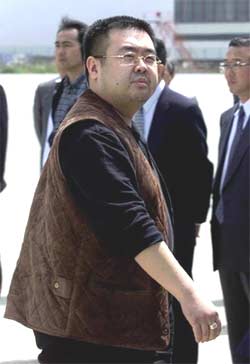
Happy Holidays from Santa Kim Posted by Hello

13 December 2004

Glass Relations Between Pyongyang and Beijing

North Korea has completed, ahead of schedule, the "concrete frame project on the main production floor of a melting shop" of the Taean Friendship Glass Factory, According to a Dec. 11 report by the KCNA. The report adds, "Achievements made in the construction of the factory which will record another chapter in the annals of the DPRK-China friendship greatly encourage the Korean people in their dynamic drive to honor their national economic plans for this year with flying colors."

Now, while a glass factory seems minor news, particularly one that isn't even built or operational, I bring this up because the factory happens to be the only tangible piece of evidence provided by the KCNA a few days earlier for the so called "Year of Epochal Significance in DPRK-China Friendship."

A December 6 KCNA report of that title listed all the things that made 2004 an "epochal" year. They included:

1. The unofficial visit of leader Kim Jong Il to China in April ("a new milestone in the development of the bilateral friendship").
2. The visit by a delegation led by Kim Yong Nam, president of the Presidium of the Supreme People's Assembly of the DPRK, to China in October ("once again demonstrat[ing] the invariable stand of the Party and government of Korea to carry forward the friendship").
3. The visit of a delegation led by Wang Jiarui, head of the International Liaison Department of the Central Committee of the Communist Party of China, to the DPRK in January.
4. A visit by Chinese Foreign Minister Li Zhaoxing to the DPRK in March.
5. A visit by Li Changchun, member of the Standing Committee of the Political Bureau of the Central Committee of the CPC, to the DPRK in September.
6. The donation by China to North Korea of the Taean Friendship Glass Factory.

So basically Kim Jong Il went to China (or was summoned to Beijing), some Chinese folks came to the DPRK (mostly to put the squeeze on Kim to get with the program on the nuclear talks), and the Chinese gave a glass factory to the DPRK, which is now only partially built. And this constitutes an "epochal year" in bilateral relations. For two nations once "as close as lips and teeth," this seems a pretty poor representation of epochal relations.

China has had very conflicting feelings on North Korea in recent years, on the one hand using its historic relationship with Pyongyang to position itself as the key player in the nuclear negotiations (an attempt to gain unrelated concessions from the United States, South Korea and Japan), but on the other hand, with North Korea not playing entirely by China's rules, and providing the excuse for Japan's military re-alignment and more leverage for Washington than Beijing, the Chinese have been conflicted with how best to deal with their wayward neighbor.

So Pyongyang comes out, ever the optimist, and calls a relatively poor year for relations "epochal." Whatever it is they put in their Kimchi there, one wonders if that is what their diplomats got kicked out of Turkey for. But in the end, Pyongyang has little interest in being subservient to Beijing, but it does want to remain on China's good side and retain its position as a recipient of Chinese aid and assistance. And if that comes in the shape of a glass factory (as opposed to copious amounts of cash, oil and food that somehow Pyongyang failed to mention in the article), then so be it.

06 December 2004

Christmas Greetings From "Fat Bear" Kim Jong Nam


Kim Jong Nam in Japan, May 2001 Posted by Hello


Everyone’s (well, at least MY) favorite Dear-Leader-to-be Kim Jong Nam has gotten an early start on his Christmas cards this year, according to the Japanese press. The younger Kim was thought at one point to be first in line to succeed his father Kim Jong Il, son of Kim Il Sung, dynastic founder of the Democratic People’s Republic of Korea. That is, until his little embarrassment in May 2001, when he was picked up in Japan for illegal entry while trying to go to Disney.

Well, the Fat Bear (Pang Xiong was his false name on his passport back in 2001, a humorous play on his rolly-pollyness) has now sent a Christmas email to several Japanese media folks he accidentally met back in September in an airport in Beijing. The greeting, sent from a Yahoo Korea account and written in Hangul, read:

“Hello, I am Kim Jong-nam. I was glad to meet you all at Beijing International Airport on September 25. The season's-end is near and the New Year is approaching. I wish you all good health and happiness. December 3, Kim Jong-nam.”


Takashi Uemura, a reporter for the Asahi Shimbun, replied to the Kim e-mail:

“Where are you now? I would like to meet you again.”


To which he received the cryptic reply:

“I am not in a position to clearly answer what you want to ask. I just sent the greeting as I was given a name card.”


Now, all this is quite pleasant. I mean, here we have someone thought to be the son of the leader of one of only two Axis of Evil members, sending out holiday greetings to folks he met only briefly at the airport a few months ago. Now, if only Washington would let North Korea alone, perhaps the eventual succession from Kim Jong Il to Kim Jong Nam would solve everything.

And remember, if you ever meet a dictator-in-waiting at the airport, always err on the side of manners and exchange a card, and perhaps share a spot of tea and some biscuits. You never know whose Christmas card list you may end up on.

04 December 2004

Defense Minister Subdues DPRK in Ninety Minutes

South Korean Defense Minister Yoon Kwang Ung, speaking Dec. 3 before the National Assembly Budget and Accounts Committee, said “If a war were to break out, our forces can respond quickly and should be able to subdue the threat posed by these weapons within an hour or an hour-and-a-half.”

Yoon’s confidence is encouraging, but not necessarily all that accurate. The weapons he is referring to are some 10,000 artillery and rocket units on the North Korean front lines. And while these may be out of date systems, they are anything but obsolete given that they are designed for a saturation attack of the greater Seoul area (one of the reasons the US forces are moving South of the Han River).

As of 2001 (the last time I’ve seen such statistics bandied around), the North Korean artillery barrage takes place in the following time sequence.

14 minutes from “Go” order to first shots fired.
110 seconds flight time from muzzle to target.
10,000 rounds per hour.


This is the basis of North Korea’s frequent “Sea of Fire” comments. Most of these systems are kept in hardened bunkers or hollowed out mountains – thus the 14-minute set-up time. But in addition to this, North Korea maintains a missile arsenal, numbering as high by some estimates as 800 short- and medium-range missiles. Many of the artillery shells, rockets and missiles are capable of carrying chemical or biological warheads as well as conventional explosives.

In comments earlier this year, General Leon LaPorte, Commander, United States Forces Korea (USFK), said that despite the aging nature of the North Korean military, it is quite capable of causing “great destruction and casualties if they chose to attack.” LaPorte did say that the South Korean and U.S. forces are capable of defending the South against a North Korean attack – ultimately.

Seoul alone certainly doesn’t have the armament yet to take on the frontline North Korean artillery in an hour or an hour and a half. South Korea was long held back in its development of surface-to-surface missiles (Washington didn’t want the South to launch a pre-emptive strike on the North, and thus precipitate another major war on the Peninsula).

In recent years, Seoul has added AGM-142 Popeye air-to-surface missiles for their F-16s (111 km range for the missiles), as well as ATACMS Block 1A surface-to-surface missiles (300 km range). But these are in relatively small quantities, and while several more recent studies suggest that the South Korean military, in a one-on-one fight with the North Koreans, are more likely to win in the end, wiping out Pyongyang’s frontline artillery in an hour is excessively optimistic.

That said, South Korea IS moving toward a more independent defense capability, and continues to develop its own ballistic missiles and spy satellites, as well as additional defense technology. And what it can’t develop, it is seeking to buy. Ultimately, Seoul has little intention of using its military against the North, and would much rather integrate its technology with the North’s manpower (and nukes?) to create a stronger and significantly more independent military force. And given the pace of military and technological evolution in China and Japan, and the growing tensions in Northeast Asia, Seoul may find its defense buildup much earlier than it currently perceives.

02 December 2004

The Korea That Can Say "Roh"

In comments that I thought would get more airtime inside and outside Korea, President Roh said in Britain this week that “No country” can enforce an option unacceptable to the South Korean people to resolve the dispute over North Korea's nuclear program, because South Korea’s “national capacity guarantees this.” Roh added that Seoul (or HIS government) “will exercise a say that befits [South Korea’s] national capacity and status."

The comments are just the latest in Roh’s continued play on South Korean nationalism as a tool of legitimacy and a projection for a more independent (militarily and politically) and economically powerful South Korea. To some extent, Roh is pressing for South Korea’s Juche – the self-reliance of the Koreans to guide their own future on an economic, political, security and unification level. Roh has also accelerated Seoul’s plans for a more independent defense posture, again a mirror (though somewhat less polished) of North Korea’s Songun politics, the “military first” idea that without a strong and independent military, political and economic strength and independence are nigh impossible and certainly un-insurable.

I have been watching these trends for some time in Korea, subtle undercurrents in the social psyche, stirred by the collapse of the Soviet Union, the capitalismization of China, the shifting U.S. defense posture, the economic boom of the early 1990s, the economic bust of the late 1990s, the “Korean wave” of culture spreading through Asia, the inter-Korean summit of 2000, and many other issues.

All of this is the basis of the book I am writing in my spare time (yes, I know there is no such thing as spare time, and yes, I know everyone is writing a book), which will be titled The Korea That Can Say "Roh" - a clever play on words of Ishihara’s book if I do say so myself, and one intended not to be a comparison of Korea and Japan as much as to chronicle and explain how Roh is a RESULT of changes in Korean society, not the DRIVER of such changes.

Over time I plan to post bits of the text, the outlines and the like, and any comments/observations will be appreciated and noted.