
One of the most striking things about the six party talks in Beijing this week is the fact that it appears four of the six parties have little to do. Earlier in the week, the Russian delegate even announced when he would leave – even if the talks weren’t over.
U.S. Assistant Secretary of State Christopher Hill and North Korean Vice Foreign Minister Kim Kye Gwan have been holding their own set of talks, pausing occasionally to attend the six party talks, it appears. The two met July 25, 26, 28 and 29 for bilateral discussions.
Perhaps this is a sign that this round of talks may actually accomplish something rather than be confused by the myriad (and quite frequently contradictory or at minimum totally unrelated) national interests of the other four players.
30 July 2005

27 July 2005
Kim’s Military Tour and Readings to Pass the Time

As the six-party talks got underway in Beijing, North Korea prepared to mark the 53rd anniversary of the signing of the Armistice Agreement. In the days leading up to this momentous occasion (the anniversary and the talks), Kim Jong Il made several visits to military facilities in the North.
On July 17 he dropped by the “newly-built general foodstuff processing factory under KPA Unit 534.” Two days later, he visited the “Unit 937 honored with the title of Kum Song Lifeguard situated on the forefront.” On July 20, he “inspected the command of KPA Unit 118,” and on the 21st he “inspected KPA Unit 2653.” After a visit to a saltern in Wonsan Bay, he resumed military visits July 23, inspecting “companies under KPA Unit 287,” and on July 25 he “inspected KPA Unit 503.”
Kim clearly made it a point to highlight his military just before the six-party talks resumed. The fact that he had such a fll schedule also suggests whatever major decisions or possible outcomes he expected from the six-party talks he felt he was pretty secure on, and didn’t take one of his long-times-off to devise a new strategy or prepare to make a major policy shift.
As folks await the outcome of the current round of six-party talks, here are a few things to read to add some background knowledge or alternative viewpoints.
Armistice Agreement
Chosun Sinbo on DPRK-US Relations
Agreed Framework (DPRK Pub)
Agreed Framework (Via Arms Control Association)
The Treaty on the Non-Proliferation of Nuclear Weapons (NPT)
North Korea Nuclear Program Map and Chart (From CEIP)
A few studies on the 1993 nuclear crisis
The 1993 North Korean Nuclear Crisis: A Foreign Policy Analysis
The North Korean Nuclear Proliferation Crisis
Nautilus Institute’s DPRK Briefing Book
23 July 2005
Can't We All Just Be Friends?
With just days to go before the resumption of the six-party talks in Beijing, North Korea reiterated its long-standing (but infrequently stated) optimal solution to the 2003 nuclear crisis (now two-years past the intended North Korean date of resolution). In a Foreign Ministry statement released by the KCNA, Pyongyang cited the imminent 52nd anniversary of the 1953 Armistice Agreement (July 27, one day after talks resume) and said he best solution to the nuclear crisis is a formal peace accord with Washington to replace he Armistice.
The key paragraph follows:
Essentially, Pyongyang says that the whole reason North Korea pursues nuclear weapons is to defend against the United States. And the reason that is necessary is because there is no formal peace mechanism between the two states. If there were, and the Armistice Agreement was replaced with a formal peace treaty, then Pyongyang would no longer feel threatened and no longer need nuclear weapons. Crisis solved in one simple step. No energy deal needed, no excessive payments of cash simply not to be bad.
Now, this is not necessarily reality. But this remains one of the core goals of North Korea, even if its methods (threatening nuclear weapons production and ballistic missile sales) appears a little counter-intuitive. Pyongyang feels embattled. It is one of the few relics of the Cold War (Cuba is another) that remains a semi-viable state, and it is convinced that Washington would like nothing more than to overthrow the North Korean regime and replace it with a “democratic” one. Pyongyang still has delusions of grandeur when it comes to U.S. priorities, but the fear of being sidelined from the global stage is certainly accurate.
By so blatantly stating their goal, of course, North Korea is finally realizing that the game is one they can’t win in the post-911 world. Washington just doesn’t play around like that. No guarantees a solution will be reached, but Pyongyang is obviously ready to get this self-made crisis over with and move on with other priorities, like trying to rebuild an economy without losing total political control. Its all fun and games until someone loses a regime.
The key paragraph follows:
Replacing the ceasefire mechanism by a peace mechanism on the Korean Peninsula would lead to putting an end to the US hostile policy towards the DPRK, which spawned the nuclear issue, and the former's nuclear threat and automatically result in the denuclearization of the peninsula.
Essentially, Pyongyang says that the whole reason North Korea pursues nuclear weapons is to defend against the United States. And the reason that is necessary is because there is no formal peace mechanism between the two states. If there were, and the Armistice Agreement was replaced with a formal peace treaty, then Pyongyang would no longer feel threatened and no longer need nuclear weapons. Crisis solved in one simple step. No energy deal needed, no excessive payments of cash simply not to be bad.
Now, this is not necessarily reality. But this remains one of the core goals of North Korea, even if its methods (threatening nuclear weapons production and ballistic missile sales) appears a little counter-intuitive. Pyongyang feels embattled. It is one of the few relics of the Cold War (Cuba is another) that remains a semi-viable state, and it is convinced that Washington would like nothing more than to overthrow the North Korean regime and replace it with a “democratic” one. Pyongyang still has delusions of grandeur when it comes to U.S. priorities, but the fear of being sidelined from the global stage is certainly accurate.
By so blatantly stating their goal, of course, North Korea is finally realizing that the game is one they can’t win in the post-911 world. Washington just doesn’t play around like that. No guarantees a solution will be reached, but Pyongyang is obviously ready to get this self-made crisis over with and move on with other priorities, like trying to rebuild an economy without losing total political control. Its all fun and games until someone loses a regime.
21 July 2005
Terrorists, Infiltrators, Defectors, Deserters, Gangsters or Hooligans?
Yonhap reports that three men in their 20s with short hair, wearing tight t-shirts and dark pants, drove up to two South Korean soldiers on patrol near Donghae, Kangwon province at around 10:10PM July 20, asked the soldiers for directions, and then stabbed them (on in the arm, the other unknown at the moment), tied their hands with tape and threw them in the trunk of their car. The then drove them to a nearby Navy base, threw them out and took off toward Gangneung with one K-1 and one K-2 rifle (each with a 15-round magazine) and a walkie-talkie.
The timing of the incident (less than a week before the expected restart of the six-party talks) may simply be a coincidence, but the word “coincidence” always makes me nervous. At the moment, there are too many possibilities for the perpetrators – terrorists or North Korean infiltrators, ROK deserters or defectors, or even gangsters or college hooligans. The K1 at one point had a civilian version that still has a good resale value overseas.
The question that immediately comes to mind, however, is whether this has to do with North Korean agents or not. That they took the soldiers to the Navy base, and apparently didn’t do a really good job stabbing them, appears to belie this theory. The ease with which the three guys with knives overpowered two soldiers with loaded weapons may instead suggest some sense of cooperation – after all, the wounds weren’t too bad, and the soldiers may be sharing in the resale profits from the guns. But I wouldn’t take a knife to the arm for a 1/5 share of four or five hundred dollars and the chance of being caught.
So this seems to leave a youth gang, perhaps pining for the day they were in the military, or recently let out with nothing better to do? If they are just planning to resell the guns, it might be the end of the story. But given some of he tensions between US forces and ROK citizens recently, one can never be too careful. Certainly, though, this is going to turn into another scandal for the ROK military, which has certainly had its share this year. Maybe a ground-up review of military force structure is finally in the offing.
The timing of the incident (less than a week before the expected restart of the six-party talks) may simply be a coincidence, but the word “coincidence” always makes me nervous. At the moment, there are too many possibilities for the perpetrators – terrorists or North Korean infiltrators, ROK deserters or defectors, or even gangsters or college hooligans. The K1 at one point had a civilian version that still has a good resale value overseas.
The question that immediately comes to mind, however, is whether this has to do with North Korean agents or not. That they took the soldiers to the Navy base, and apparently didn’t do a really good job stabbing them, appears to belie this theory. The ease with which the three guys with knives overpowered two soldiers with loaded weapons may instead suggest some sense of cooperation – after all, the wounds weren’t too bad, and the soldiers may be sharing in the resale profits from the guns. But I wouldn’t take a knife to the arm for a 1/5 share of four or five hundred dollars and the chance of being caught.
So this seems to leave a youth gang, perhaps pining for the day they were in the military, or recently let out with nothing better to do? If they are just planning to resell the guns, it might be the end of the story. But given some of he tensions between US forces and ROK citizens recently, one can never be too careful. Certainly, though, this is going to turn into another scandal for the ROK military, which has certainly had its share this year. Maybe a ground-up review of military force structure is finally in the offing.
18 July 2005
North Korea-Taiwan Arms Cooperation?
A man using the alias Kim Il Do, who claims to be a member of the North Korean Supreme People’s Assembly, defected to the South via a third country in May, 2005, according to South Korean media and government reports. The Chosun Monthly, which broke the story, said Kim was originally a South Korean who defected to the North during the Korean War and, until his defection, was affiliated with the Maritime Industries Research Center under the Second Economic Committee, which reportedly is involved in the development and sales of weaponry overseas.
Kim reportedly told South Korean intelligence that North Korea has developed a one-ton nuclear bomb, but that it is of indeterminate reliability, and that Pyongyang is actively working to produce a 500kg bomb. Pyongyang is also developing stealth mini-subs and some sort of sonar-absorbing underwater uniforms for infiltration purposes. In addition, Kim has reportedly traveled to Taiwan sometime in the past to discuss the possible sale of missiles to Taipei.
Now, it would seem on the surface that North Korea would have nothing to do with Taiwan, the arch-enemy (?) of Pyongyang’s key ally China. But North Korea and Taiwan maintain economic relations (see chart) and, in June 2002, Wang Yung-ching, Chairman of Formosa Plastics Group (FPG), traveled to Pyongyang to discuss possible investments. While little came of this specific trip (as Wang needed to carefully balance his search for cheap facilities with his relations with Beijing, which was non-too-happy with Pyongyang at the time), in October of the same year, Pyongyang and Taipei floated the idea of reciprocal economic offices in each others capitals.
But perhaps most interesting, particularly in light of Kim’s revelations, was the rumored October 1998 visit by a Taiwanese National Security Bureau (NSB) team to Pyongyang to discuss the establishment of a Taiwanese listening and intelligence gathering post in North Korea and the potential purchase of missile, submarine and potentially nuclear technology. The unconfirmed reports, in Hong Kong’s Yazhou Zhoukan, certainly raised a lot of eyebrows at the time, and now may find some backing.
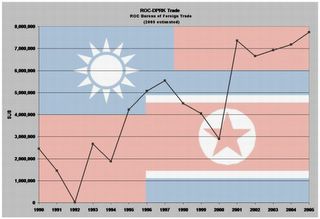
ROC-DPRK Trade
Kim reportedly told South Korean intelligence that North Korea has developed a one-ton nuclear bomb, but that it is of indeterminate reliability, and that Pyongyang is actively working to produce a 500kg bomb. Pyongyang is also developing stealth mini-subs and some sort of sonar-absorbing underwater uniforms for infiltration purposes. In addition, Kim has reportedly traveled to Taiwan sometime in the past to discuss the possible sale of missiles to Taipei.
Now, it would seem on the surface that North Korea would have nothing to do with Taiwan, the arch-enemy (?) of Pyongyang’s key ally China. But North Korea and Taiwan maintain economic relations (see chart) and, in June 2002, Wang Yung-ching, Chairman of Formosa Plastics Group (FPG), traveled to Pyongyang to discuss possible investments. While little came of this specific trip (as Wang needed to carefully balance his search for cheap facilities with his relations with Beijing, which was non-too-happy with Pyongyang at the time), in October of the same year, Pyongyang and Taipei floated the idea of reciprocal economic offices in each others capitals.
But perhaps most interesting, particularly in light of Kim’s revelations, was the rumored October 1998 visit by a Taiwanese National Security Bureau (NSB) team to Pyongyang to discuss the establishment of a Taiwanese listening and intelligence gathering post in North Korea and the potential purchase of missile, submarine and potentially nuclear technology. The unconfirmed reports, in Hong Kong’s Yazhou Zhoukan, certainly raised a lot of eyebrows at the time, and now may find some backing.
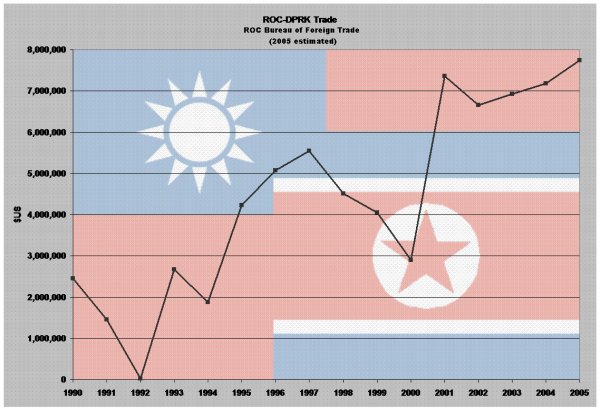
ROC-DPRK Trade
14 July 2005
"A Serious Act of Aggression on South Korean Sovereignty"
In a classic case of overstatement, South Korea’s Foreign Ministry responded to Japan’s expected protest over the name of the new ROK LPX – Dokdo – by saying, “Protests from the Japanese government are tantamount to a serious act of aggression on South Korean sovereignty.” The statement went further to add, “The South Korean government will consider any claim to the Dokdo islets by Japan as a provocation to Korean sovereignty. We will counter those provocations with firm resolution.”
Now, Seoul was quite aware that naming a mini-aircraft carrier/amphibious assault ship “Dokdo” would raise the ire of Tokyo. The whole issue over Dokdo is not necessarily the historical animosity (though there is a lot of that in the social context) but instead the location of the maritime border, and control over the resources below (from fish and crabs to potential energy and mineral resources). The new LPX serves to further “expand” the ROK maritime border, just as U.S. aircraft carriers and the mini-carriers that haul the Marine Expeditionary Units “expand” the U.S. to any point in the world, allowing the U.S. to exert influence from its own floating pieces of the mainland.
Seouls response to the expected Japanese protest is, not unexpectedly, over the top – “a serious act of aggression on South Korean sovereignty?!” It sounds like Hideyoshi landed his forces in Korea again and had already marched half-way to Seoul. But in a nation where political bickering runs deep in the fledgling democracy, anything that can provide a sense of national unity – even if an overblown case of nationalistic rhetoric over a few rocks and an intentional act of rhetorical provocation on the part of Seoul – is something the government sees as beneficial.
Now, Seoul was quite aware that naming a mini-aircraft carrier/amphibious assault ship “Dokdo” would raise the ire of Tokyo. The whole issue over Dokdo is not necessarily the historical animosity (though there is a lot of that in the social context) but instead the location of the maritime border, and control over the resources below (from fish and crabs to potential energy and mineral resources). The new LPX serves to further “expand” the ROK maritime border, just as U.S. aircraft carriers and the mini-carriers that haul the Marine Expeditionary Units “expand” the U.S. to any point in the world, allowing the U.S. to exert influence from its own floating pieces of the mainland.
Seouls response to the expected Japanese protest is, not unexpectedly, over the top – “a serious act of aggression on South Korean sovereignty?!” It sounds like Hideyoshi landed his forces in Korea again and had already marched half-way to Seoul. But in a nation where political bickering runs deep in the fledgling democracy, anything that can provide a sense of national unity – even if an overblown case of nationalistic rhetoric over a few rocks and an intentional act of rhetorical provocation on the part of Seoul – is something the government sees as beneficial.
12 July 2005
Dokdo Rules the Seas...
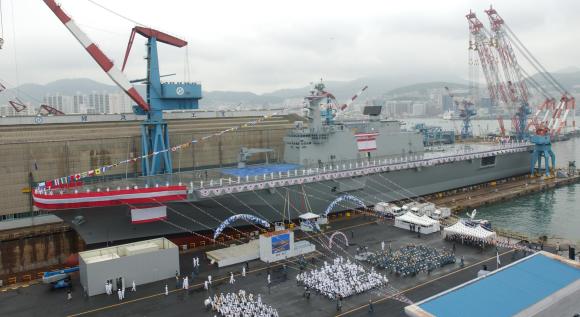
The launching of the LPX Dokdo in Pusan July 12, 2005. (Photo from Korean Ministry of National Defense)
The South Korean Navy July 12 launched the Dokdo, a 13,000-ton multipurpose “LPX : Amphibious Ship Transport New Designs” that will serve as both landing and air operations. In effect, it is a light helicopter carrier, carrying some 700 troops, 10 CH-60 Seahawk helicopters, six tanks, seven amphibious vehicles and two landing boats. It is a little smaller than a U.S. Tarawa-class LHA, used by the Marine Expeditionary Units for rapid deployment in disaster and contingency operations.
Korea is not alone in the development of helicopter carriers in Asia. In 2000, Japan quietly approved the creation of two new “helicopter destroyers” (DDH), each around 13,500-tons, to come into service before 2010. The flat tops would be helicopter carriers, rather than the current destroyers with rear-deck helicopter pads, capable of carrying large numbers of evacuees below decks – or of course carrying troops to a contingency. While Japan’s constitution kept the terminology cryptic, it is obvious Tokyo, too, is preparing for a more active role in regional contingencies, both near and on-shore.
This turns attention to China, which has recently restarted work on the old Russian Varyag, which sits in dry-dock in Dalian after a long journey from Ukraine toward an ostensible destination as a casino in Macao (never happened, though). It is unlikely Beijing is planning to float the Varyag as a fleet carrier – the cost is too prohibitive to float a status symbol, and without at least two other carriers, the Varyag serves more of a PR role than an effective military vessel. Whether the Varyag will end up a casino or a military museum – or will be re-floated and sold abroad or used for near-shore landing practice is not clear.
What is clear is that there is an increased interest – and now visible action – on the deployment of helicopter carriers for regional contingencies, and that Seoul has beaten Tokyo to the punch. And Seoul’s choice of names – Dokdo – is a clear message to Japan, given the longstanding debate over the ownership of the islands.
11 July 2005
Back to the Table
If you happened to catch North Korea’s announcement July 9, Pyongyang has decided to return to the six-party talks during the week of July 25. Now, not to say “I Told You So” but, if you look back to my July 1 post, I noted:
Now, I based that date on several factors, including Chinese president Hu Jintao’s visit (which couldn’t be until sometime after July 8, given the Kim Il Sung death day memorial) and the simple fact that Pyongyang was trying originally for the crisis to be solved in 2003 in time for the 50th anniversary of the signing of the Armistice Agreement (July 27) – so talks should begin on or a little before that date this time around, as Pyongyang still likes to play up symbolism and history.
China is in the midst of several visits to North Korea before Hu’s visit to shore up a more unified approach to the six-party talks, and other diplomatic visits and discussions are in full swing. The Hu visit will be most interesting. Pyongyang chose to give China a little knock by announcing the return to the talks before Hu’s visit. While Beijing can still claim credit for convincing Pyongyang to return to the table – given other envoys like Tang Jiaxuan – it makes Hu’s visit now look like he is returning a favor to the North, not coming to give fatherly advice and direction to the wayward regime.
North Korea is in the final stages of setting up the conditions for a return to the six-party talks, likely around the 25th of July.
Now, I based that date on several factors, including Chinese president Hu Jintao’s visit (which couldn’t be until sometime after July 8, given the Kim Il Sung death day memorial) and the simple fact that Pyongyang was trying originally for the crisis to be solved in 2003 in time for the 50th anniversary of the signing of the Armistice Agreement (July 27) – so talks should begin on or a little before that date this time around, as Pyongyang still likes to play up symbolism and history.
China is in the midst of several visits to North Korea before Hu’s visit to shore up a more unified approach to the six-party talks, and other diplomatic visits and discussions are in full swing. The Hu visit will be most interesting. Pyongyang chose to give China a little knock by announcing the return to the talks before Hu’s visit. While Beijing can still claim credit for convincing Pyongyang to return to the table – given other envoys like Tang Jiaxuan – it makes Hu’s visit now look like he is returning a favor to the North, not coming to give fatherly advice and direction to the wayward regime.
09 July 2005
Kim Il Sung, 11 Years Ago
July 8, 1994: President Kim Il Sung dies of a myocardial infarction while preparing one of his dachas for a visit by then South Korean President Kim Young Sam for what was to be the first ever inter-Korean summit. Now, given all that was going on (the nuclear issue, Kim’s sudden decision on the barge with Jimmy Carter to resolve the nuclear issue and have the visit from Kim YS, there remains some suspicion that Kim’s heart attack may not have been induced only by stress, but perhaps other contributing factors. After all, there was a major purge rumored once Kim Jong Il came in, and plenty of reports of military officials dieing of rapid lead poisoning on a hill overlooking Pyongyang. Now, it could be that Kim Il Sung’s decisions to change North Korea back in 1994 (changes only now being slowly put in place by Kim Jong Il) were because he new his death was imminent, or it could be that the changes so challenged the status quo for the elite that they couldn’t allow them to occur. Either way, Kim JI operates under a relatively narrow realm of constraints – he cannot continue to maintain the country under the closed system reliant on the (not so) good will of the Chinese and Russians; neither can he rapidly change the country and remain in power. In all cases, each reform threatens his grip either through the potential backlash by those disenfranchised or losing some privileges or by the interim instability the reforms create (see the troubles Beijing continues to face with its reform, and the steady rise in social uprisings).
Song of General Kim Il Sung
Condensed Biography of Kim Il Sung
Brief Biography of Kim Il Sung
Short Biography of Kim Il Sung
Chronology of Kim Il Sung’s Major Activities
Kim Il Sung Study Room
Song of General Kim Il Sung
Condensed Biography of Kim Il Sung
Brief Biography of Kim Il Sung
Short Biography of Kim Il Sung
Chronology of Kim Il Sung’s Major Activities
Kim Il Sung Study Room
06 July 2005
Beijing Tests North Korean Waters
Liu Jingqin, former Vice Minister of the International Department of the Communist Party of China Central Committee (IDCPC) and now Vice-President of the Chinese People's Association for Peace and Disarmament (CPAPD) arrived in Pyongyang July 5, according to KCNA.
In his previous role, Liu served from the mid-1990s to the early 2000s as part of China’s Party-to-Party apparatus for maintaining primarily PR ties with other Communist and Leftist parties around the globe. Liu made several overseas visits in that role to Europe, Latin America and North Korea.
More recently, Liu has joined with the CPAPD, an NGO-type organization (despite informal links with the central government) that serves as an umbrella for several Chinese disarmament organizations focusing on the elimination of nuclear weapons, space-based weapons and other war technology.
Liu’s visit to Pyongyang offers an informal way for Beijing to test the waters of the North Korean leadership in anticipation of a potential trip by Chinese President Hu Jintao to North Korea to meet with North Korean leader Kim Jong Il. Hu will not go to Pyongyang unless he can gain assurances from Kim to play along with the six-party talks and thus give China additional leverage in dealing with the United States.
Washington has recently called off the congressional attack dogs and delayed debate on the Schumer bill, and in return, Beijing is expected to provide the “quo” – North Korean acquiescence or at least a return to the table – in return for Washington’s “quid.” Should Pyongyang fail to play along, Beijing loses nothing by the unofficial NGO visit by Liu. Should Pyongyang play ball, another, more formal visit will come to finalize Hu’s travel plans.
In his previous role, Liu served from the mid-1990s to the early 2000s as part of China’s Party-to-Party apparatus for maintaining primarily PR ties with other Communist and Leftist parties around the globe. Liu made several overseas visits in that role to Europe, Latin America and North Korea.
More recently, Liu has joined with the CPAPD, an NGO-type organization (despite informal links with the central government) that serves as an umbrella for several Chinese disarmament organizations focusing on the elimination of nuclear weapons, space-based weapons and other war technology.
Liu’s visit to Pyongyang offers an informal way for Beijing to test the waters of the North Korean leadership in anticipation of a potential trip by Chinese President Hu Jintao to North Korea to meet with North Korean leader Kim Jong Il. Hu will not go to Pyongyang unless he can gain assurances from Kim to play along with the six-party talks and thus give China additional leverage in dealing with the United States.
Washington has recently called off the congressional attack dogs and delayed debate on the Schumer bill, and in return, Beijing is expected to provide the “quo” – North Korean acquiescence or at least a return to the table – in return for Washington’s “quid.” Should Pyongyang fail to play along, Beijing loses nothing by the unofficial NGO visit by Liu. Should Pyongyang play ball, another, more formal visit will come to finalize Hu’s travel plans.
01 July 2005
Hey, Look at Me! I'm Doing Something Bad...
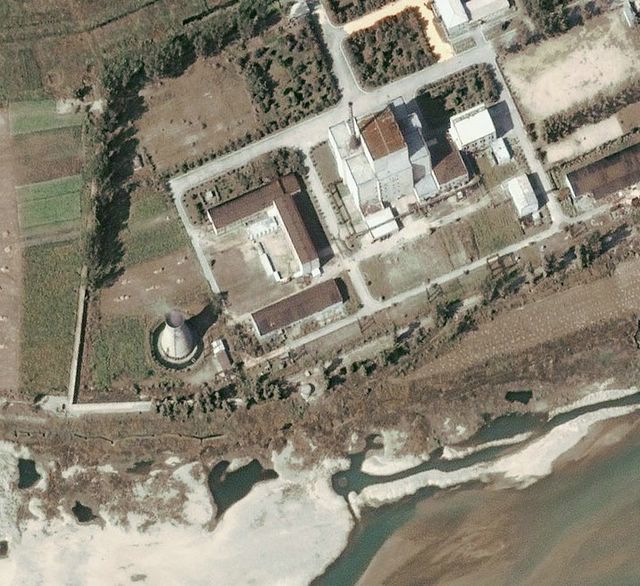
Yongbyon, North Korea. Image from DigitalGlobe (www.digitalglobe.com )
North Korea recently restarted work on two nuclear reactors, one at Yongbyon and another at Taechon. The move was plenty obvious – North Korea well knows the number of satellites focused on its nuclear facilities and is quite aware that any activity, particularly large-scale ground leveling and construction work – will be seen. And obviously that is what Pyongyang wants.
North Korea is in the final stages of setting up the conditions for a return to the six-party talks, likely around the 25th of July. The upcoming visit to Pyongyang of Chinese President Hu Jintao will lay the groundwork for a more unified Chinese/North Korean position, while Pyongyang has already held several round of talks with South Korean officials and has made known to the untied states via the New York channels the limits of its bargaining position.
Restarting construction on the two stalled reactor projects is simply one more item Pyongyang can trade away in the talks – an item that of course was a non issue earlier this year. North Korea is king at creating false senses of crises in order to trade away issues and actions and return to the status quo while gaining concessions from the United States, Japan and South Korea.
Washington is aware of this, but given the souring of relations with China, the United States is looking more seriously at a resolution of the North Korea issue to take away some of Beijing’s levers. And Beijing is seeing the North Korea lever as ever-so useful once again.
And the winner is… North Korea (once again).
Subscribe to:
Posts (Atom)

