26 February 2005

Headline of the Week

Without a doubt, the Chosun Ilbo wins this week's semi-annual periodic Headline of the Week award for this ethnically-inspired gem:
Seoul Must Nip Japanese Provocation in the Bud

The entire article can be found here.

19 February 2005

Kim Reappears - At a Russian Dance Show

North Korean leader Kim Jong Il has once again made a public appearance, after laying low for the Lunar New Year celebration, preparing for his birthday celebration and announcing to the world that he has nuclear weapons. Kim took in a Russian song and dance performance, according to KCNA. The art troop performed such classics as “In Memory of Defenders of the Motherland,” “Evening in Suburbs of Moscow,” “Song Devoted to Comrade Kim Jong Il,” and of course “Song of General Kim Jong Il” and “General of Korea.”

Just a bit of trivia, the Song of General Kim Jong Il (available for download at NAENARA site) was one of the songs that North Korea claims to have broadcast from the Kwangmyongsong satellite, which was what the 1998 Taepodong launch was supposed to have put into orbit. Most evidence, however, shows a failure of the third stage seperation, and the satellite simply plopping down in the Pacific - on the other side of Japan.

15 February 2005

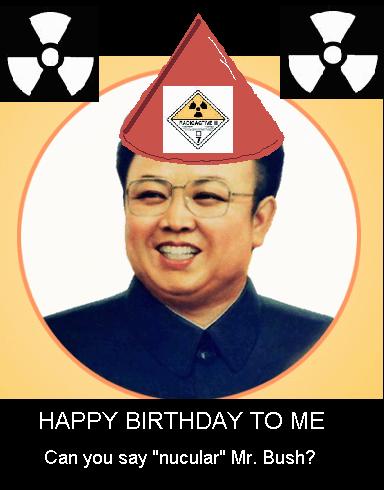
A Birthday Card For the "Dear Leader"


A day early, but he already announced his present anyway... Posted by Hello

13 February 2005

Clearing Away the (mushroom?) Clouds

For those of us who, professionally or personally, follow North Korea – the “Pyongyangologists” as it were – this past week has been tremendous.

First, the simple fact that North Korea sort-of officially said it had nuclear weapons was one of the most over-played statements in a while. North Korea has never really denied it had nuclear weapons; it has simply played coy, claiming the right to have weapons, but leaving their actual existence up to the imagination. And Washington has supplied plenty of imagination, holding relatively consistently that North Korea has three to eight nuclear weapons (that is, until North Korea agreed – then Rumsfeld said he wasn’t sure there were any North Korean nukes).

Second, listening to the media has been a blast, as the circular reporting, errors, agendas and punditry abound. Now, North Korea may have a “bad” regime (though not as bad as Sudan, if you believe Parade Magazine), but if you really want to understand what is going on, and perhaps even suggest a viable solution for the perceived and actual ills, it is important to take a cold, hard, unbiased and impersonal look at the North Korean regime; to walk a mile in Kim Jong Il’s shoes (are they lifts?) and see the world through his and his regime’s eyes.

Third, and this is something I bet every blogger out there truly deep down can relate to, I have become quite popular this week for my opinions and observations on the Korean situation (and hence I have had little time to actually write anything down). There is something about a little “fame” that boosts one’s ego now and again. I even received e-mail from folks I haven’t seen in a decade asking about the North Korean statement. Go figure.

I already wrote a little on the situation right after the announcement was made, but now I think it about time to get back on that bandwagon and pontificate further.

Take a look over at the Center for Korean-American Peace (CFKAP), which is run by Kim Myong Chol, the “unofficial” spokesman of North Korea. Mr. Kim travels Japan and the United States, as well as occasionally returning to North Korea, and offers his own insight into the decision-making processes in Pyongyang, as well as offering Pyongyang his insights into the inner-workings of Washington (whether either are all that accurate has yet to be fully tested, but he does seem to offer at least one alternative point of view to look at the actions of Kim Jong Il and company from that is likely much closer to the real way they think than some British or American academic or talking head can offer).

In his Feb. 10 comment on the DPRK Foreign Ministry announcement, he starts with a fairly provocative “The Bush Administration, which calls itself champion of freedom and enemy No. 1 of tyranny, should not dither in calling the North Koreans' bluff by launching a surgical nuclear strike on the Democratic People's Republic of Korea (DPRK).” Now, one would think that North Korea’s unofficial spokesman wouldn’t call down a sky-full of PGMs on his homeland, but this is not atypical of a Kim Myong Chol commentary

Kim MC has long agreed with most of the western specialists that the North Korean regime is seeking preservation. But where they leave off (North Korea’s leadership is not suicidal, and is therefore always bluffing), he adds another level – that North Korea’s leadership sees another way to ensure security, and this is through the real and proven possession of nuclear weapons. Kim MC argues that the domino effect that Washington fears – a nuclear-armed North Korea triggers proliferation in Northeast Asia as Japan, South Korea and perhaps even Taiwan also develop nuclear weapons – is in fact beneficial for North Korea (even if it is not the desired path).

While this seems rather counterintuitive, it is important to understand the logic that goes into such analysis – and perhaps into the decision-making process in Pyongyang. North Korea, since the end of the Cold War, has been without a sponsor. During the Cold War, the inefficient economic system worked fine – as long as it was propped by the Russians or the Chinese. Kim Il Sung also was, well, a “Great Leader” compared to his son, as he has true revolutionary credentials and spent as much time as possible interacting (or at least being seen interacting) with the people. You never see pictures of Kim Jong Il sitting in the dust laughing with half-a-dozen peasants.

With the end of the Cold War, North Korea was left to dangle as the appendix it appears on a map, and after Kim Il Sung held his first nuclear crisis, he almost managed to reshape North Korea’s position in the world, and nearly met with Kim Young Sam – that is if his heart hadn’t stopped working. What might have been is left to speculation, but it took more than three years for Kim Jong Il to pull things together before he threw his own nuclear crisis. By then, economic mismanagement, a lack of external sponsors, under-developed charisma and a series of natural disasters left the country in sorry shape.

Kim Jong Il’s greatest fear was that he would be removed from power – and that fear is shared by many of the elite in the North Korean regime. If you were met with deep bows everywhere you went, were given all the luxuries you could reasonably need in an isolated socialist state, why would you risk losing that stature and privilege by opening to outsiders or even merging with the South? Kim fears internal unrest, disloyalty, and, most of all, the United States. Kim is convinced (and Washington does little to truly dissuade him of this) that the United States will take any opportunity to overthrow the Kim dynasty.

Kim Jong Il has sought security guarantees from the United States for years – this is the underlying purpose for the periodic nuclear crises, as odd as that may seem – and he really wants to have a formal peace accord and diplomatic relations with the Untied states. That would not only raise his stature (and that of North Korea) but also offer a greater reassurance that regime change will no longer be the operative U.S. object. Of course, after observing the U.S. involvement in Ukraine, even this appears to offer little sense of security.

And thus the other reason for a nuclear program – the development of nuclear weapons. While the core of the DPRK strategy has been to make Washington so scared of the idea of a nuclear-armed North Korea and the possible regional domino effect that Washington signs a peace accord, if that doesn’t happen, there is the nuclear option. Pyongyang has little intention of ever launching a war, but it does want to ensure no one launches a war on North Korea, and nuclear arms help ensure that. In addition, by having nuclear weapons and even triggering Japan to have nuclear weapons, it reduces the overall influence of the United States, as the U.S. nuclear umbrella no longer is the only game in town.

Now, while this may not seem like the best plan, it is not about good or bad but about understanding how the other party thinks – and thus being better prepared to devise a counter-strategy. Note that the big loser in all of this is China, which has managed to avoid having to deal with a number of smaller nuclear parties in its neighborhood. That would not b the case if the domino theory is accurate, and Beijing would find itself facing its regional rival, the world’s second largest economy, armed with nuclear weapons and back on a track as a “normal” nation, without constitutional restraints on having a military.

10 February 2005

Happy New Year Part II

North Korea has welcomed the Year of the Rooster by crowing about its nuclear weapons.

In a KCNA-released statement from the Foreign Ministry, Pyongyang has, in less than its typically ambiguous terms, stated bluntly
“We… have manufactured nukes for self-defence to cope with the Bush administration's evermore undisguised policy to isolate and stifle the DPRK.”


Now, this statement comes out in the middle of the New Year holiday, just a week before Kim Jong Il’s birthday celebration, amid rumors of internal fractures in the North Korean regime and talk of further dynastic succession and just as the United States embarks on its new second-term foreign policy initiatives.

It is important to note that this is a rhetorical shift, not a substantive one. North Korea has not tested a nuclear weapon, it is unclear they have a delivery system, and they are clearly still in negotiating mode. That said, they are a wily bunch up their on the other side of the DMZ, and you have to watch them closely.

And watch the neighborhood, because Japan is looking for public excuses for its military transformation, and North Korea is constantly sitting as the prime foil. A confirmed and formally nuclear North Korea is one of those potential first dominoes – leading to Japanese, South Korean and even Taiwanese nuclear weapons and reshaping the fundamentals of the security system in Northeast Asia.

For the moment, it is this potentiality that North Korea is trying to exploit. Pyongyang needs to end the current nuclear crisis, to demonstrate its strength and to move forward with other initiatives. If it can regain the top spot in the U.S. foreign policy agenda, it wins. Whether Washington will bite, however, is another story.

08 February 2005

Happy New Year!

Welcome to the year of the rooster.
Here’s a couple of SeolNal links to ring in the New Year.

SeolNal from KCNA
SeolNal from KNTO
SeolNal from Life in Korea

07 February 2005

Economic Rumbles as Whisky Imports Fall

So it seems whisky and brandy imports fell in 2004, down 15 and 36 percent respectively. Now, that may not seem like a big deal, but this is part of an overall 8 percent drop in alcohol imports, the first drop since 1998.

Anecdotally (as I haven’t gotten around to find the numbers again), Koreans were importing massive amounts of foreign whisky and brandy in 1995 and 1996 – and if I remember correctly, Korea even ranked as the number one destination for at least one type of high-quality (and price) French alcohol.

In the 1990s, prior to the Asian economic crisis, Koreans were profligate spenders – they bought anything luxury (alcohol, golf clubs, cars with like 100 percent added import taxes) and made it a point to live up to the conspicuous consumer appearance of a booming economy.

Of course, the economy was not all it appeared to the outside, and was caught up n the collapse like many of its neighbors. And down went alcohol imports. Koreans turned again to their domestic brews like soju and imported cheap foreign beer and wine. But of course, the sense of embattled economy dissipated, an Koreans again started spending – as seen in a tiny part by the rise in expensive alcohol imports.

The precipitous dip in 2004, then, appears to reflect a natural move by Koreans to react to economic problems. There are an estimated 1.3 million working poor, some 76,000 jobs were lost form Dec. 2003 to Nov. 2004, and inflation stood at 3.6 percent in 2004.

But things may be changing as Koreans look at home for ways to save – and accelerate the economy. The consumer expectations index rose in January, domestic car sales began rising again in December, as did credit card use and service industry output.

Korea has always shown a particular skill in recovering from various troubles and crises, and the shift to domestic sales and purchases seems to be a natural move by the society to once again adjust. Whether it will insulate the country from the rumblings in China – which threatens to shake the rest of the region – remains to be seen.

04 February 2005

KCNA running short of Vitriol

In an update to my rant yesterday, take a look at this KCNA report and tell me what is wrong. I’ll give you a hint, there are no condemning diatribes, no complaints about the evil intents of the imperialists or their puppets, no talk about threatening the peace of the Korean peninsula or vows to defend the homeland and the honor of Kim Jong Il.

Seriously, this is one odd piece of KCNA reporting.

Plan for Tactical Exercise of S. Korean Army in Bitter Cold Announced
Pyongyang, February 2 (KCNA) -- The "Metropolitan Garrison Command" of the south Korean army announced that its units' tactical exercise in the depth of winter would be launched near Mt. Kwanak in Seoul on Jan. 31 under the simulated conditions of repelling the infiltration of some forces, according to KBS of south Korea. The drill which will last till Feb. 4 will reportedly involve the firing of blank shells, helicopter mobile and search exercises, ambush, etc.

03 February 2005

"You're an 'Outpost of Tyranny...'"

Pyongyang has finally responded to the “outpost of tyranny” comment by U.S. Secretary of State Condoleezza Rice by saying, well… You are an outpost of tyranny…

North Korea’s weekly Tongil Sinbo labeled the United States the “main post of tyranny,” a remark reminiscent of one a three year old would toss at a fellow day care denizen.

Now, why it took more than a week for Pyongyang to come up with such a weak retort I don’t know, but could it be that Pyongyang’s top schools of journalism no longer turn out the quality propagandists they once did? Even in the 1990s, Pyongyang could still churn out such classics as "running dog," "sea of fire" and others like:

“Kim Young Sam of South Korea, a political prostitute and a Judas of modern version” (KCNA, March 5, 1997)

A “top foreign policy maker of the Japanese ruling Liberal Democratic Party… has become a political illiterate and amaurotic person who cannot tell a from b but only acts as told by the U.S. and the puppets.” (KCNA, June 10, 1997)

In reference to a South Korean Defense Minister – “A mad dog deserves beating with a stick.” (KCNA, April 6, 1999)

“The South Korean authorities[‘]… rash act aims at currying favor with their master, the U.S. flunkeyism makes a person an idiot.” (KCNA, December 7, 1998)

“U.S. brasshats' clamourings about "check of threats from someone" and "deterrent to war" are nothing but an artifice to cover up their nature as warmongers.” (KCNA, December 10, 1998)

Turning around “outpost of tyranny” to “main post of tyranny” is really beneath the capabilities of North Korean propagandists. If Pyongyang’s sloganeering is fading to such weak levels, maybe all the rumors of the collapse of the regime being nigh are more prescient that they first appeared…

02 February 2005

Kim Jong Il travels, but will he cross the DMZ?

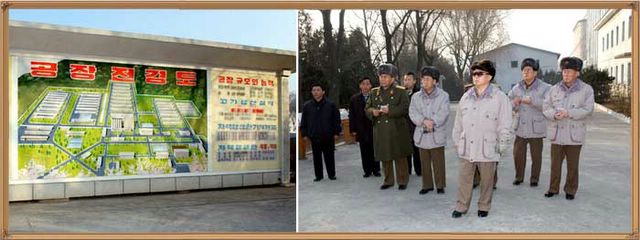
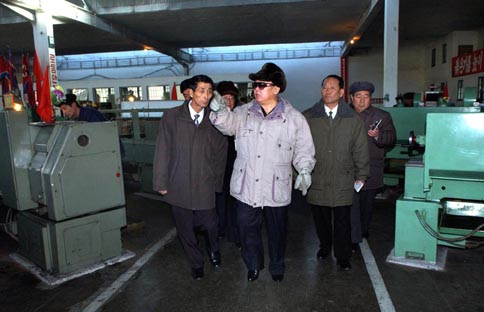
With all the speculation in the Asian and American press of the potential for unrest and instability in the North Korean government, and the reports of the groundwork for succession, I thought I'd post a few pictures allegedly showing Kim's most recent visits, including a trip to a machine shop, a military unit and a pig farm - Industry, Military and Agriculture. All he needs is a visit to a symphony or an art exhibit and he will have visited all the pillars of North Korean society (and I wouldn't doubt if one isn't reported soon.

Kim is nearing another Birthday (Feb. 16) and all of North Korea (or at least the parts in the state news) are ramping up for the momentous occasion. But even more so is Pyongyang's attention on another key date in September - the 60th anniversary of Korea's division. Pyongyang missed its 2003 plan for diplomatic relations with the United States to mark the 50th anniversary of the Armistice Agreement, it does not want to pass September and still be fighting the same old nuclear crisis three years running (the latest one began in October 2002).

There are repeated denials in the South of a Roh-Kim summit (no one suggested one, so they are either begging or protesting a bit too much), Moscow has offered a possible venue, though Kaesong may end up being more accurate, and likely in August, around liberation day, rather than Moscow's May invitation. (I remember seeing the Kimjongalia hung up on the platform in Seoul right next to the Munghwa in August 2000, quite a shocker at the time, though there was still the euphoria of the summit a few months earlier).

Kim Jong Il inspecting pig farm of Unit 966, Jan. 28 (from http://www.uriminzokkiri.com/) Posted by Hello

Kim Jong Il inspecting Unit 347,Jan. 27 (from http://www.uriminzokkiri.com/) Posted by Hello

Kim Jong Il at Rakwon Machine Complex, Jan. 14 (from http://www.chongryon.com/index-k.htm) Posted by Hello