29 October 2005

A Little More Arirang

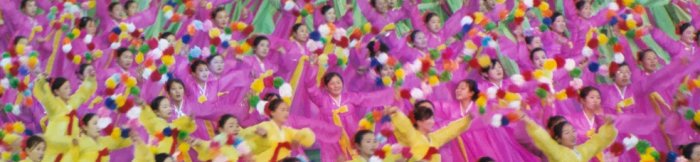
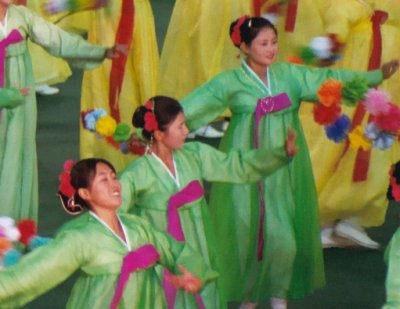
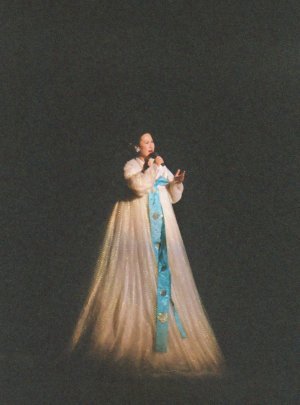
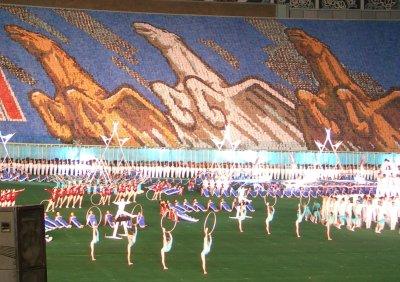
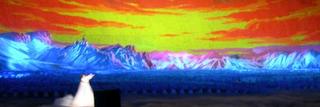
Before the move on to Kaesong, a few more Arirang Pictures.
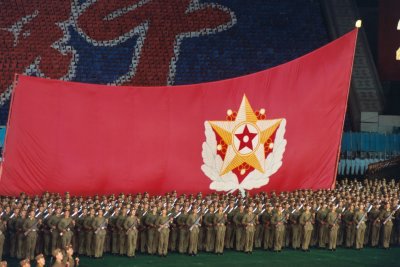
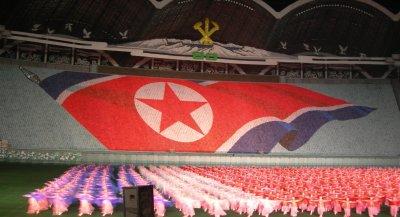
The 60th Anniversary of the founding of the Workers' Party of Korea (WPK)


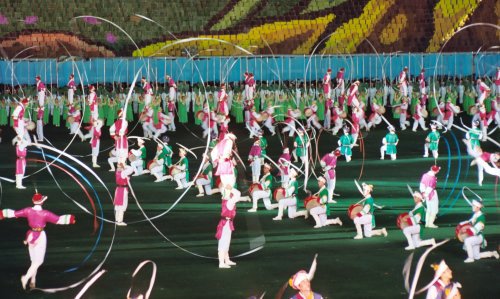
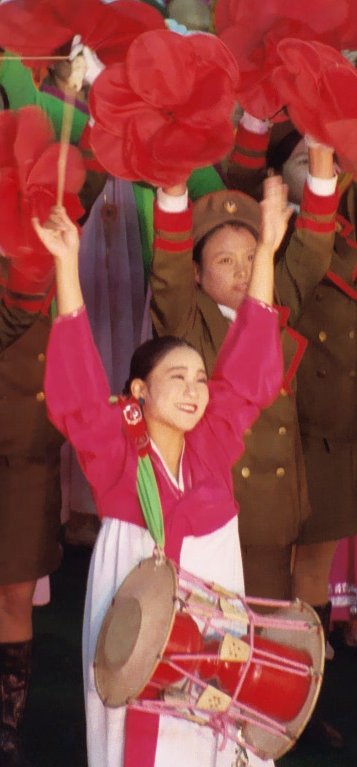
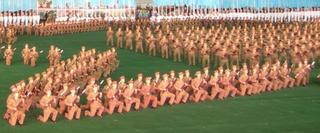
Some of the lovely sailor drummers. One of the Arirang images that filtered through my dreams...
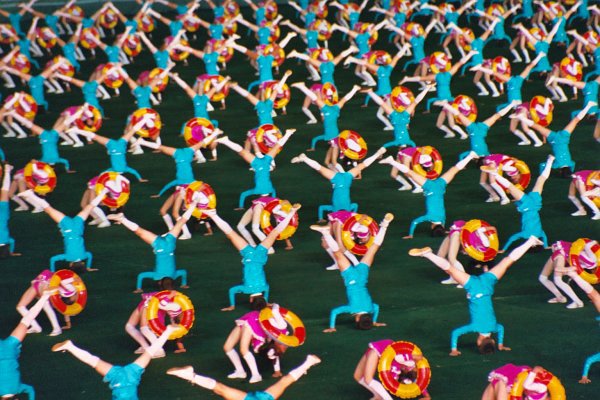
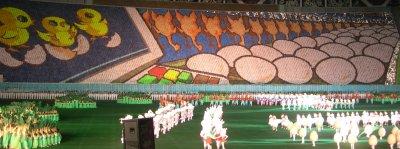
The childrens' displays were some of the most impressive and yet odd. But it is enough to make any gym teacher in America cry with jealousy.

A much more expansive version of the spinning hat dance seen all the time in the South. Despite the North's insistance on using history as a justification for everything, there was not nearly as much visible "historic" or "folk" images, dances, songs or architecture in the parts of the North we were allowed to see.


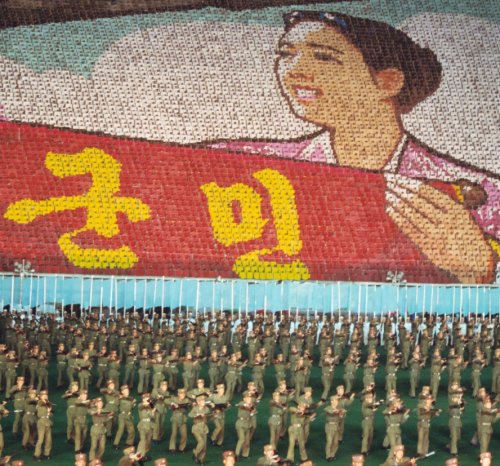
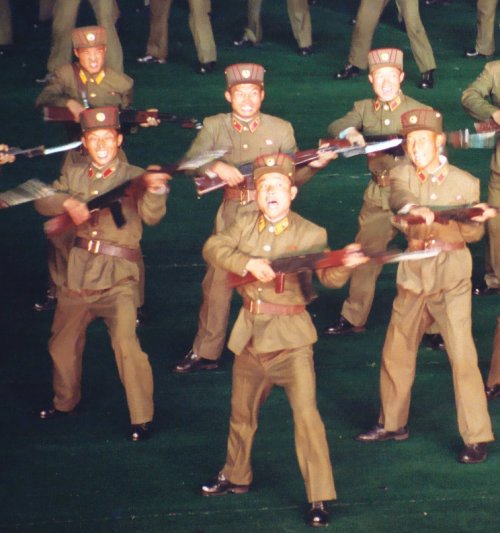
While the paratroopers and the bayonetting of U.S. GIs were removed from this performance of Arirang, there were still plenty of opportunities to see soldiers mimicking drill.
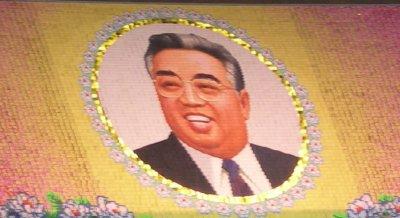
Unification and reconciliation with the South were key elements.

28 October 2005

A Pause

With the Mass Games under my belt, and the strains of Arirang still ringing my our ears, we file out of the stadium, past the throngs of South Koreans waving their blue and white unification flags, past the hanbok-clad female ushers, forbidding us to take pictures up into the stands, past the soldiers in green, chests adorned with medals, past the throngs of North Koreans, past the souvenir shops, selling the same books and postcards (many in languages other than English – the first batch of Arch of Triumph postcards I had were in Arabic...).

After the bright spectacle, the city seems even darker on the bus ride home; no street lights, no traffic signals, few cars, yet still people walk the sidewalks, waiting at the bus stops, the electric trolleys spark a brilliant blue, like an oversized flashbulb, and then darkness again. The two streetlights outside the hotel shine a dull amber, but look brilliant compared to their darkened cousins along the streets.

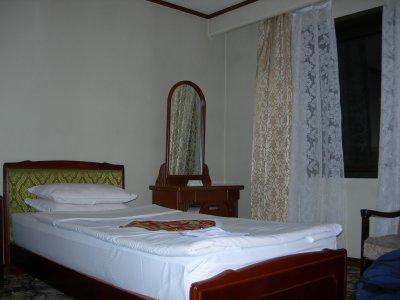
In the hotel room, the North Korean television channels are already off for the night, and there are but few lights still on in the apartments across the street. The bed is firm, the Korean comforter typically heavy, sleep comes quickly, flashes of the performance chasing across the insides of my eyelids. Tomorrow – Kaesong.

27 October 2005

Mass Marketing the Mass Games

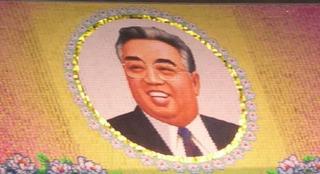
The official reason for our trip to the workers’ paradise was to observe the Arirang Mass Games, a spectacle of music, marching, dancing and gymnastics, with a backdrop of some 50,000 school kids flipping colored cards to make murals of revolutionary feats throughout the history (and future) of North Korea.
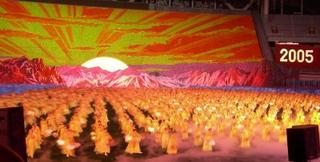
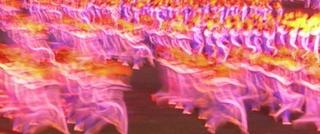
Our guides on the bus struggled with explaining the concept of “Arirang” to us, saying it was a story of a boy and a girl, separation, love, the history and soul of the nation, and, well, after we saw it they would try again. (A Yonhap explanation and recording is available, and several versions of Arirang Song can be found at the Music from Korea page, including a few particularly ... um ... rockin’... versions of Arirang, one by the Yoon Do Hyun Band or another by Shin Hae Chul/NEXT.) In essence, Arirang is a folk song, sung un both North and South, that has come to symbolize the trials of the Koreans, their love for their homeland, and their desire for the reunification of the nation and peoples.
Now, seeing North Korea’s Arirang Mass Games performance is quite a different thing. First off, the 2005 version is a rerun. Yes, even North Korea is apparently running out of ideas. Well, perhaps it is, as Broadway would term it, a “revival,” rather than a rerun. The 2002 performance was such a big hit that they brought it back for 2005 – only slightly modified to remove most of the anti-U.S. propaganda. In fact, that was one of the disappointments of the whole trip for me; the dearth of quality anti-U.S. propaganda. It was like they toned down the whole country for our visit.
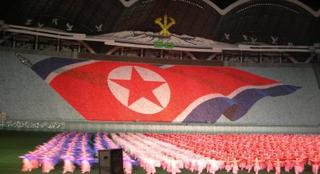
In fact, it is broader than that. Pyongyang is well versed in propaganda and rather skilled in its deployment (despite such seemingly odd phrased as “human scum”...). The shift has been noticeable not only regarding anti-U.S. propaganda, but also anti-South Korean [puppet regime] propaganda. Pyongyang is working to reshape its image and its population to better fit into a future (and currently emerging) situation in which economic and social cooperation with South Korea grows, and in which, at some point, North Korea and the United States normalize relations. This isn’t tomorrow, but it takes a while to change some 60 years of ingrained and enforced thinking.
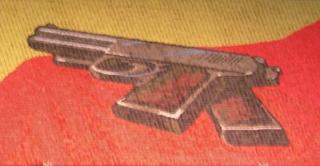
Now, as for the Mass Games themselves, they were equally impressive and bizarre, spectacular and disturbing. As I watched with rapt attention at the near perfection of movement by hundreds if not thousands of performers on the field and their living backdrop in the opposite stands, I was thinking about the discipline, skill and commitment necessary to pull it all off – and wondering if that was really the best way to utilize the human capital in Pyongyang.
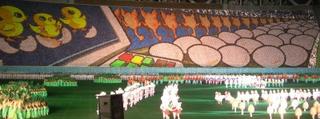
In some sense, the Mass Games give the youth something to shoot for – the chance to be the best of the best, to perform, perhaps even in front of the Dear General (a good movie to watch on this is A State of Mind, made in part by the folks at Koryo Tours). This is important, as the overwhelming sense I got from the adult population is that there is no chance now or ever for upward mobility. So while they will work their fingers to the bones for their children (as Koreans in the South also do), if it wasn’t for the overwhelming sense of embattlement in the country (the sense that America is intentionally keeping them down and could attack at any moment), there would be little drive for social order.
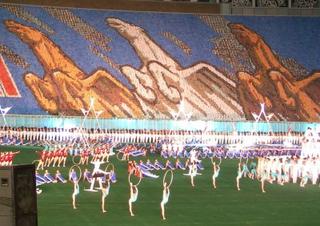
But back to the Mass Games, because I know you are all waiting with baited breath to hear about them. But can words describe the games? It is stunning. It is strange. Hundreds of young girls twirling hula-hoops on their feet... in unison. Lady soldiers in skirts playing snare drums and high-stepping to the rhythm. Huge images of catfish, ostriches and guns along the back wall. A laser show with goats and fat pigs. Thousands of soldiers with bayonets swinging them with simultaneous shouts. Trapeze artists falling several stories onto a net. A motorcycle high-wire act. Giant bungee slingshots throwing acrobats into the air. Children dressed as chickens, rabbits and eggs. A mass display of jump ropers.

An artistic, acrobatic, athletic, military, circus, musical smorgasbord extravaganza.
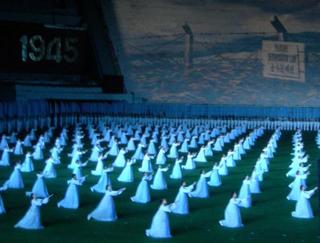
And all the while the South Korean tourists wave their unification flags and cheer or cry, the Americans gawk, and the North Koreans beam proudly as their children perform a quality rendition of a child swimming at the beach.
A few links to see video clips, order the DVD, or read other accounts.
Video footage from Dan Schorr
Video, photos from North Korea "Arirang" state culturefest
Pyongyang Mass Games Take Spectacle to Another Level
Spectacle spares little in celebrating party's 60 years
Trying to meet the people in N Korea
Arirang Mass Games VCD From KFA (overpriced compared to on-the-ground, but oh well)
What's the Frequency Kim? by Simon Cockerell

26 October 2005

A Bright Hotel in a Dark City

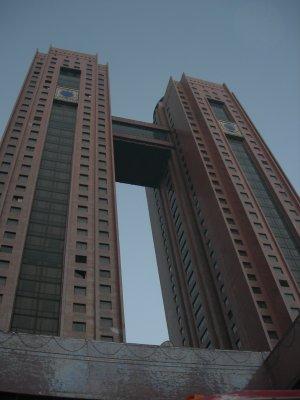
The Koryo Hotel in downtown Pyongyang is a massive 40+ story set of twin buildings, connected with an aerial walkway making the entire structure look like an “H” standing on a pedestal. The towers are a pinkish-brown, with a large gold and blue decoration several stories down from the top. The lobby is in ostentatious décor, mirrored, marbled and bedazzled.

While the hotel is lit up, the only streetlights contributing to the scene outside are he two directly in front of the hotel. The rest of the city is dark, aside from the lights coming from the windows in the apartment blocks along the road. The traffic girls, in their blue skirts, continue their robotic movements in the intersections, with lit wands guiding the few remaining cars on the road. People wait by the bus stops for the electric trams or the buses, or walk down the sidewalks in the dark.

We drive off to the restaurant, a hot pot joint already decked out for us. This is our first meal in North Korea, and we are quickly introduced to the fact that there is only one drink for the round-eyed big-nosed imperialist American aggressors – North Korean Beer. Every meal in North Korea (aside from breakfast) is accompanied by two large bottles of beer at the table. If you ask, there is occasionally bottled water, fresh from the springs of Mount Kumkang.

After dinner it is off to the stadium, with our large souvenir tickets tucked in our pockets. As we near the stadium, a glow diffusing through the dusty night indicates where the Arirang Mass Games will be held – and where all the electricity that would otherwise have been available for the street lights has apparently gone.

25 October 2005

Stop One: The Arch of Triumph

We arrive at the Arch of Triumph as several busloads of South Koreans pack up and leave – but not before some take a shot at filming us. In this situation, a busload of Americans in Pyongyang are as much one of the sites as the Arch itself.
We are met at the site by the local Korean guide, a lady dressed in a think, almost velvety hanbok, dark with flowers and a shining Kim Il Sung badge over her heart. She tells us about the monument, about the anti-Japanese struggle and the glories of Kim Il Sung.

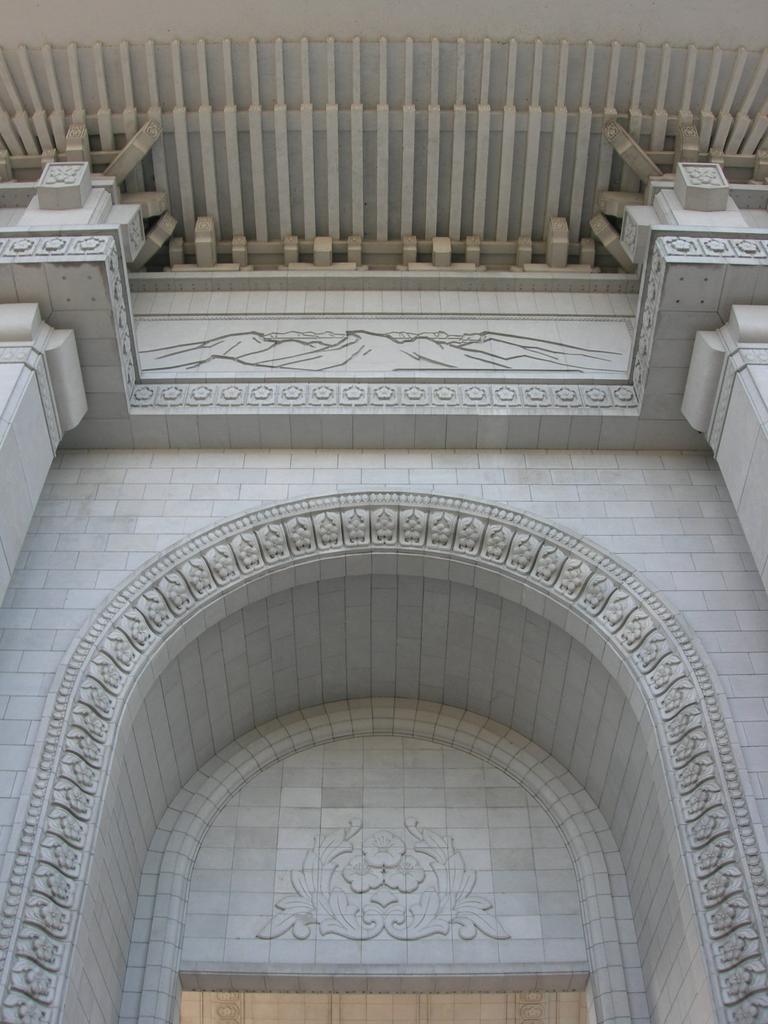
The Arch is 60 meters high, 52 meters wide, the Song of General Kim Il Sung is engraved along the top. There are 70 azalea flowers on the arch, its totals 15000 square meters. It was built in one year and eight months. These are the sorts of details we are told everywhere. The size, the details of representative images, and the relationship to the revolution or Kim Il Sung.

In the case of the arch, it marks the anti-Japanese struggle, from 1925 to 1945. Kim Il Sung led the struggle, apparently when he was 13...

Like the South Koreans, the North Koreans refer to “my country” (uri nara), when talking about their home.

Across from the Arch is Kim Il Sung Stadium, and a nearby mosaic which is 10.14 meters high (marking an Oct. 14 speech) and 45 meters wide (marking 1945).

And as we wander around looking for that perfect photo, we are hurried back on the bus – but only after a stop at the first of several souvenir stands, all of which sell the same revolutionary booklets and postcards.

As we drive to our hotel, school kids in uniforms and red scarves wave merrily at our bus. There are few cars in this part of town, giving the entire place the feel of a massive ghost town – large tree-lined avenues nearly devoid of traffic in the afternoon, massive apartment complexes with empty parking lots, a thin layer of grey dust settled over everything. There is a surreal quality to the scene, a sense of complete isolation and loneliness despite being on a packed bus. Only the red letters of the slogans and praises for the Great and Dear leaders cut through the monochromatic world around us, until we arrive at the Koryo Hotel.

Extra reading - three articles from KCNA concerning the Arch of Triumph.
Article 1, Article 2, Article 3.

23 October 2005

Welcome to the Bus

We are given three guides, a bus driver and a videographer. The guides are, almost comically stereotypically, named Mr. Park, Mr. Lee and Mr. Kim. One handles arrangements, one leads the tour, and the third sits in the back of the bus to keep an eye on everything. He is introduced, somewhat tongue in cheek, as he “head of the English department,” but as becomes quickly obvious, he is our political commissar, the man to make sure nothing untoward occurs, that not ideological barriers are crossed, and that we don’t take pictures from the bus.

This latter rule is much less about concerns for national security per se. They are not concerned that we will pass photos of strategic bridges or anti-tank barriers to the South Koreans or Americans. Rather, they want to ensure that whatever pictures we take with us out of the country are all flattering, or at least not embarrassing. There is a clear sense that they know there are problems in their own country, they openly refer to previous food shortages, but they are violently proud of their nation, not only the parts after the Korean war, or even just from the anti-Japanese struggle of 1925-45 (which Kim Il Sung apparently led at the age of 13...), but of the same 5000 years of history claimed by South Korea.

Our guides begin with our first of several indoctrination speeches. At one point he is interrupted with questions, exasperating him. He stops the questions to state clearly and bluntly that we are to listen to his speech, and no one interrupts him. He then gives a gentle laugh and carries on. He has his requirements, and we are obliged to at least remain silent while he delivers his prepared talk. My mind wanders back and forth between his words and the scenes out the window.

“There are 70 million Koreans; 20 million in the North, 40 million in the South and 10 million overseas...” Small children run across the street, giggling as we pass by. “...The Korean nation is a single nation with a single language, Pyongyang time is one hour ahead of Beijing time. In the North, we use Pyongyang time...” Men on bicycles ride along the side of the road. Past them, in the field, ladies in brightly colored padded jackets cut rice stalks with sickles, gathering bundles. “...The East Sea, or the Korean Sea, is wrongly called the Sea of Japan on some maps. This is not correct...” All along the roadside, wiry stalks of cosmos flowers add color to a bleak landscape. On the other side of the empty rice fields, the tile-roofed houses are beginning to crumble, their roofs discolored.

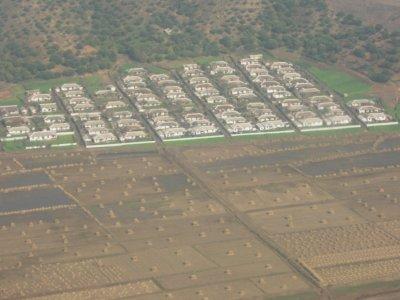
We pass on to the highway, and the guide’s speech fades into the drone of the tires. My attention is now fully absorbed by the images of the secretive land slipping by. There are several trucks on the road, many painted blue or white, some apparently hauling sacks of grain, perhaps some of the rice we saw drying outside while flying in. Green military jeeps, old Russian vehicles, pass by, occasionally stopping to pick up soldiers along the roadside. Ahead there are older ladies, backs bent, sweeping the highway with short brooms. Some men walk along in black, high-collared suits adorned with a red Kim Il Sung badge over their heart, others in dark western style suits, others in the dark blue or olive clothes so often seen in Asian Communist nations. Still others simply wear slacks and jackets, mostly in dark colors or tan.

Off in a field, an ox draws a cart piled with straw. School children, in their matching blue and white uniforms, some with vivid red scarves, pass by in small knots. As we get closer to the city, the ladies clothes take on an air of business, tight knee-length skirts, matching jackets over white blouses, far different from the clothes in the farms. We pass the globe-shaped Three Revolution Exhibition Center (the three being the ideological revolution, the technical revolution and the cultural revolution) and on past a small park, where men sit with long poles and short lines fishing. Signs in red towering letters call for a stronger revolutionary spirit, encourage respect and awe of the Dear Leader and promote unification.

And as we enter Pyongyang City, the guide once again stands up, offering us tidbits of information. “Pyongyang has a population of three million people...” We pass the Tower of Immortality, dedicated to Kim Il Sung. “The Great Leader president Kim Il Sung will always be with us...” Past the Friendship tower marking the Chinese participation in the war, and pull up to the Arch of Triumph, towering over the road.

22 October 2005

How I Got There: Part II

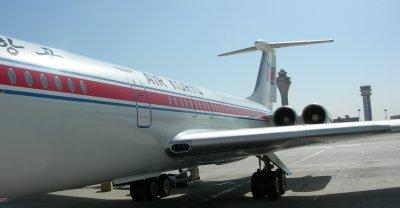
My head is growing used to the droning whine of the two Soloviev D30KU turbofans outside my window. The breathless yearning intonation of the stewardess breaks above the engine noise, but her flat English reiteration is lost in the hum. Apparently it is the food service.

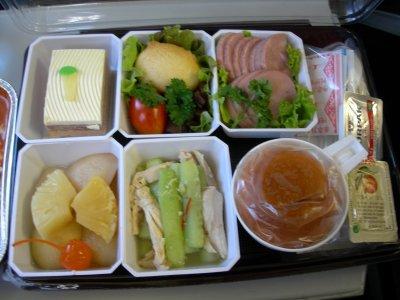
Squeezed in under-sized seats, the meal proves a challenge to eat, not due to its... interesting contents, but simply to the lack of space available. The meal is quite the spread. In addition to what appears to be a deep-fried hard-boiled egg and some mystery meat, there is a pleasant cucumber kimchi salad, a piece of cake, some beige fruit and a roll, as well as the hot meal, a potato/chicken dish in a red sauce (not spicy) with rice. Drinks include beer, beer, beer and fanta.

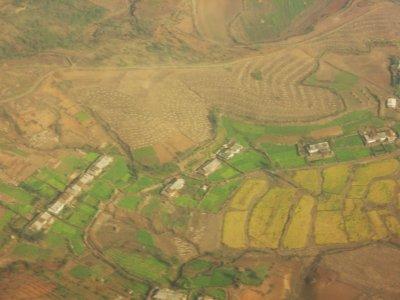
From the air, there is little difference between the North Korean countryside and th farmland in southwest South Korea. The farms and fields follow the contour of the land. But the closer we get to the airport, and the capital Pyongyang, the more regular the farms and the more neat and kept the houses.

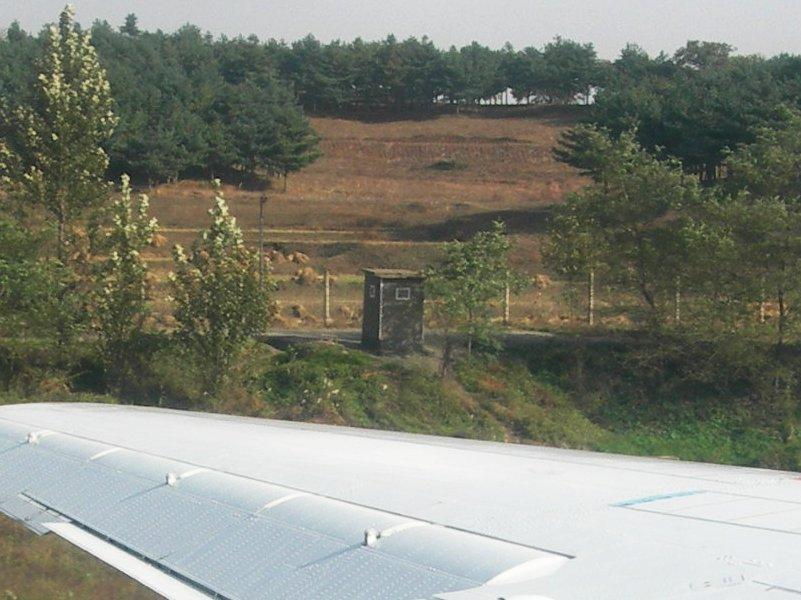
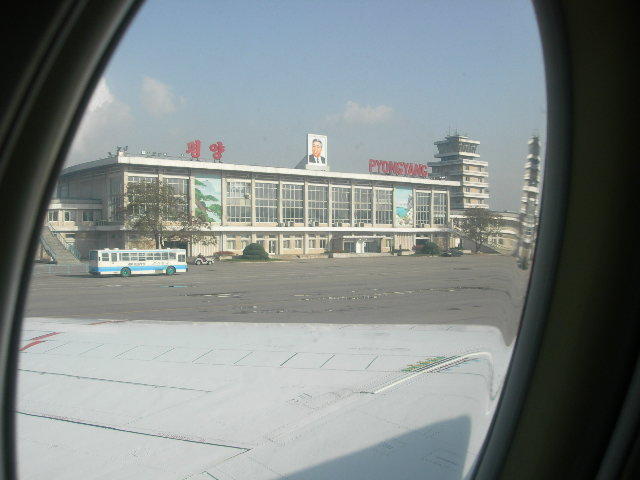
At 1400 Beijing time the wheels touch down, and after a bounce or two we are finally in Pyongyang, local time 1501. As we taxi toward the terminal, several things become apparent. First, while anti-aircraft batteries were visible from the air not far from the airport, there appears to be no ground security beyond a chain link fence and periodic small guard-houses, all seemingly unmanned. Farmers work in plots of land abutting the fence, while another rides their bicycle along a raised pathway between the fields.

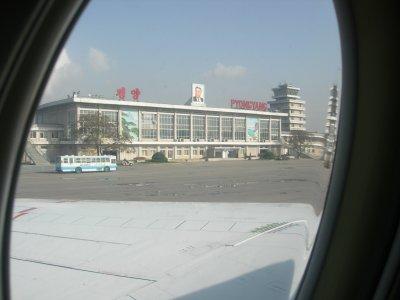
And then, out the window, shines the smiling face of Kim Il Sung atop the terminal. It is at this moment that it all becomes real. We pass an Il-76, a team of workers atop its wing, and on the other side of the tarmac sits an Asiana airliner, which at first makes me look for the MiGs that forced it to land until it dawns on me that there are large South Korea tour groups in Pyongyang at the same time.

After the excitement of passing through the vintage metal detector and sending my bags through an X-ray machine built by Roentgen himself, I emerge into the other side of the terminal, only to have my passport and return airline ticket collected by the guide. The idea is that, should I try to sneak off from the tour and rejoin them at the airport later, I will be unable to do so. This is the first introduction to the sense that I am a disease-vector and the country must be kept safe from me. It will not be the last time I get this feeling.

21 October 2005

How I Got There: Part I

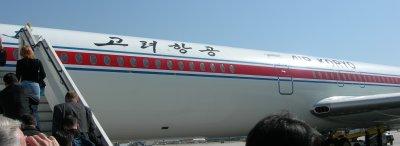
(051015:1151:On Board Air Koryo Flight 222)

Sitting aboard the Il-62, listening to the patriotic strains of martial music swell and ebb over the sound system, songs of devotion to the motherland, praising the Great Leader and Father Kim Il Sung, the Dear Leader and General Kim Jong Il, interspersed with wistful strains of nostalgic music, pining for the days long gone of the countryside and sea, the beautiful land.

The flight attendant interrupts, the breathless, nearly orgasmic sound of her voice intoning the flight time to Pyongyang, speaking in that unmistakable cadence of North Korean announcers. When shifted to English, the intonation disappears, and we are reminded “no smoke, no use of the telephone.”

Customs declarations are handed around, asking if we have any “weapon, explosive, ammunition, killing device” or “drug, exciter, narcotics, poison.”

The engines outside my window whine, scream, and the plane jerks forward. The engine noise grows deafening, the air is hot and dry, and the Il-62 begins its slow role forward down the tarmac.

A dozen minutes later and still sitting there, waiting, though the air conditioning has finally kicked in, and the air becomes more bearable, though no less stale. The engines roar as our turn comes, the plane slides back and forth across the runway as we move forward, like it were skidding on ice. The take-off is anything but smooth, accelerate, decelerate, slide left, slide right, dip and climb. The engines drown out all other sound as we slip and bounce through the hazy air over Beijing.

As we climb, the thick haze swallows the city, leaving just a blur visible through the milky sky. And then, as we continue to climb, the erratic flight smoothes out and the Great Wall slips below us, a tan line tracing the ridges of mountains partially obscured through the hazy smoke that is the Beijing air. As we head north, the mountains fade from green to red, the crisp autumn air below clearer than over the city.

14 October 2005

Wandering Beijing

I spent the day wandering Beijing, no particular destination, which meant I walked my legs off. Hopefully they will last me the rest of the trip. I only met about 10 art students trying to take me to see their displays, and I swear one of them asked me last spring…

Two surreal experiences for the day – last night watching three stooges re-runs dubbed in Chinese and today sitting in a coffee shop in downtown Beijing listening to country music. Another oddity was seeing, at the foreign language bookstore, The Rape of Nanking filed under Fiction. I thought they were quite clear it was not fiction?

The Shenzhou VI mission is on every channel and newspaper, you would think it is the 1950s and China is winning the space race. I heard an interesting insight from someone who was talking to a recent Communist Party member about the launch. The CPC member said the launch was ensuring that other countries respected China, the other fellow wrily noted that the launch only impressed the Chinese themselves, and if this happened, the Party was succeeding in regaining domestic respect. On TV, they interviewed Alexander Haig as a way to show how impressed important American government officials were hailing China's second manned space flight...

A few photos for the day.
Be Good, Dont Steal.
The Olympics are everywhere.
A little Korean advertising in Wangfujing.
Evening at Qianmen.