28 November 2005

Finishing Off Day Two

It has been a day of rapid tourism, the kind of day that, in any other place in the world, makes me stay as far from group tours as possible. But here, with little other option, I am happy to be shuttled around and sped through site after site. And while I wish there was more time for watching, for seeing, for really smelling and tasting and experiencing North Korea, I am glad to have had this bit of an opportunity.

Following the monumental tour, it was off to a pre-ordained stop at another souvenir shop. As we drive from the Monument to the Workers’ Party of Korea to our shopping destination, the contrast between old (ie post-war Soviet-assisted reconstruction) and new (ie hero-projects and monumental show-structures) Pyongyang is astounding. It boggles the mind that people don’t question the fact that they live in run down tenement style housing right next to lavish modern theaters. Or perhaps they do question these things. Perhaps there is a sense of reality, kept well concealed beneath the overt ironclad adherence and loyalty to the Juche idea, to Kim Il Sung and to his begotten successor, Kim Jong Il.

We cross the river, pass the Children’s Palace, a large, deserted department store, the Study House, the Pyongyang Grand Theater (with its traditional Korean tile roof and the mosaic of the skirted lady with a pistol), and on to the Pyongyang international Cultural Center. And it is shopping time once again. For those who live here, North Korea may be the “workers’ paradise,” but for the tourists, they try as hard as they can to make it the “shoppers’ paradise.”

But we quickly find that, while we may be whisked to several shopping locations, the fare is always the same. Ideological books and pamphlets, random selections of postcards, a few Arirang posters, commemorative coins of Kim Jong Il, Kim Il Sung and a few others, stitched pictures, miniature hanboks and Korean socks for decorations (the latter no different than all the tourist shops in South Korea)... There is no chance to get things like North Korean suits, with their high collars and dark colors, no opportunity to get propaganda posters, to get any of the socialist realism that so catches the eye.

And it’s off to dinner. Past the Pyongyang Train Station. Past an open department store, well lit inside, its rooms sparse, single product selections line walls, the stores nearly empty of customers. Several trucks pass us in the opposite direction. Some bicycles have headlights lit in the growing darkness. The flashes of the electric connections above the electric trolleys like a series of bright blue flashbulbs, or the light of a welder’s torch.

Dinner is duck, grilled at the table, served with sides, rolled in lettuce. It was, well, OK. I do not say this to be picky, either. The sliced duck heart, for example, was, well, interesting. (Getting it identified was interesting as well. We couldn’t figure out if it was liver, pate, gizzard, and so asked the passing waitress, who tapped her chest after saying “ori” (which means duck).) Having eaten plenty of Korean food in the South (and overseas), perhaps all that Cholla home cooking spoiled me, or perhaps the North Koreans were trying to adjust the tastes to fit us foreigners. Or maybe their food isn’t all that entertaining?

And our guides have one more bit of fun for us – a trip to the Yanggokdo Hotel. The casino is not all that exciting, the hotel shop is a little better than ours. Here all the South Koreans are staying, isolated on the island, quarantined from the North Korean population. The rumor is that they are locked in their rooms at midnight – from the outside. I get a chance to wander around outside, unaccompanied, in the parking lot, walking over to the waters’ edge, the Juche tower reflecting off the river. As I pace around in the cold air, I hear another set of footsteps echoing mine, on the other side of the parked busses. As I come around, there is someone trying hard not to look like they are watching me, turning to look inconspicuous as I stroll back over to the hotel.

And off we go, back to the Koryo Hotel, to our narrow, hard beds, our heavy Korean comforters and a welcome rest after a long second day.

23 November 2005

Monuments


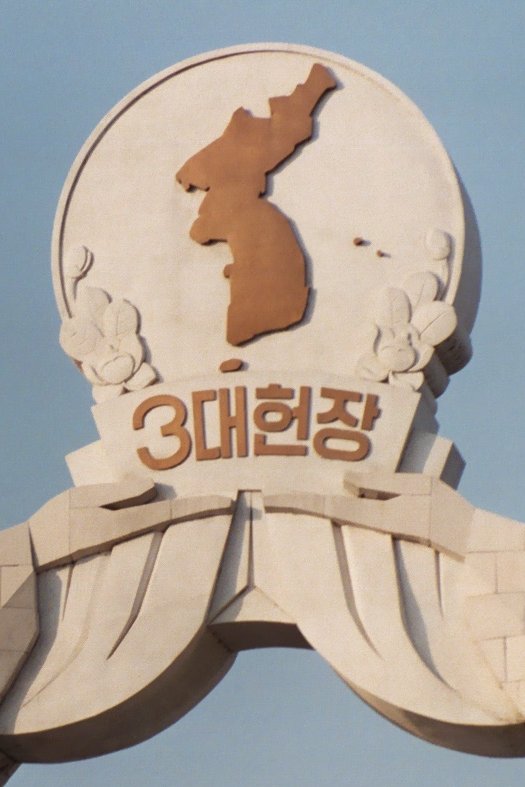
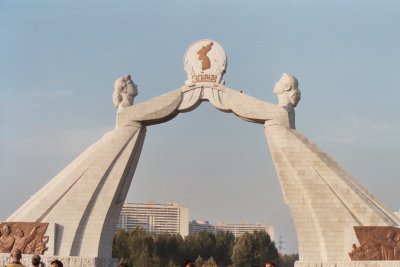
Two large stone hanbok-clad women reach upward and across toward one another, arching over the road, together holding the Korean peninsula (complete with Uleung-do and Tok-do). It is the Monument to the Three Charters of Reunification. (here is a bit from KCNA). The three charters, as the government describes them, are “the three principles of national reunification, the ten-point programme of the great unity of the whole nation and the proposal on founding the DCRK advanced by the great leader.” The monument was completed on August 15, 2001.

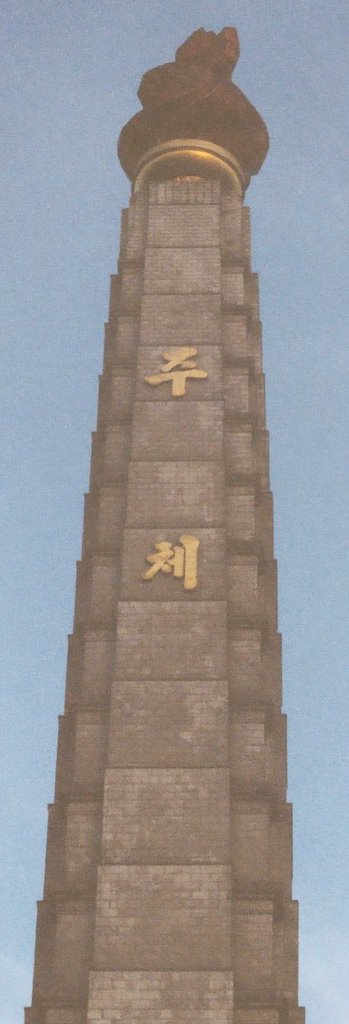
And then we were off to the Juche Tower, with the bus ride providing an opportunity for a lecture on Juche philosophy. Juche is “man” centered philosophy. If one can mobilize, organize and awaken the popular masses, they constitute a great power. If revolutionaries rely on the popular masses, they can ensure successful revolutions. In Juche, man is the master of everything. Man is the master of his own destiny, and therefore can shape destiny. (This starts to give some context to the infatuation with massive monuments and other assorted hero projects, as well as a little insight into Pyongyang’s behavior in the international community.)

The Juche calendar starts in 1912, the birth year of Kim Il Sung, but the concept of a Juche calendar did not come around until after Kim Il Sung’s death. (This is part of Kim Jong Il’s attempts to fully ingrain his father on all aspects of society, thus further legitimizing his rule.)

We drive on, a 60th anniversary of the Workers Party of Korea adding color to the scene. Out past the graying, dust covered buildings stands the glass and steel tower of a hotel. While there are storefronts and restaurants, the only open establishments appear to be the beauty salons. Schoolgirls walk by in pleated blue skirts with red scarves around their neck. People walk down the streets, some looking like farmers, others dressed in suits, leather jackets and fashionable women’s clothing.

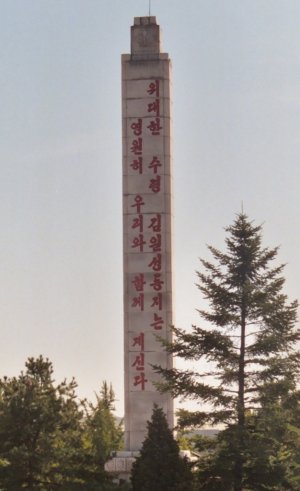
And we arrive at the Juche Tower. The tower stands along the river, offering an unsurpassed view of the city. The tower is made of 18 segments, plus the base and the torch. We walk through abandoned corridors, echoing and cold, to the single elevator and cram in for the ride to the top. Someone asks where the other numbered floors stop, the guide responds that there are no other floors. Either the numbers or the guide is misleading us.

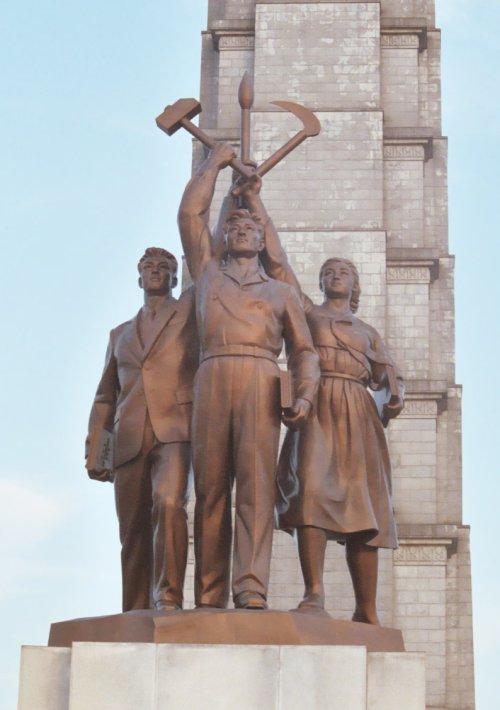
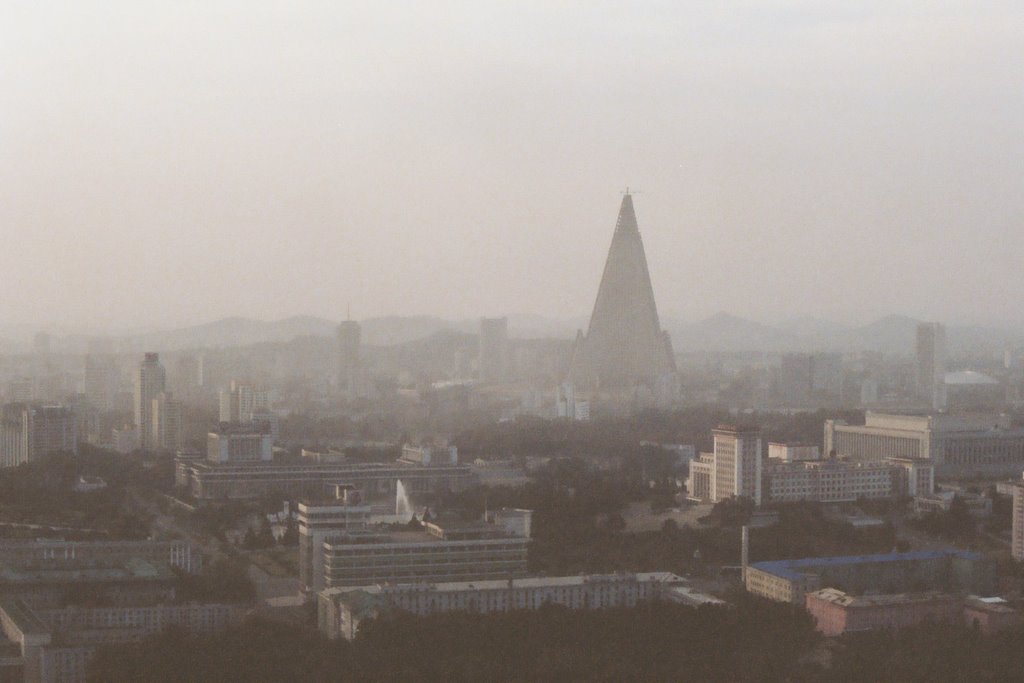
And it’s off again to the next monument. We pass an older man with his bicycle by the side of the road near an apartment block, arguing heatedly with a blue-clad traffic lady. And we arrive at the Monument to the Workers’ Party of Korea, the three tools held aloft; the workers’ hammer, the farmers’ sickle and the intellectuals’ brush. Across the street from the monument lays a broad park, flanked by apartment complexes, with the image of Kim Il Sung in the distance, and behind that the pyramid hotel. In some ways it resembles the Mall in Washington DC.


18 November 2005

The Road to Pyongyang, Part II

Time again to listen to the guide discuss politics. In his speech, there is a clear sense of embattlement, of being kept down by the United States, and wishing to get the united States to simply treat North Korea as it does any other nation – especially to end sanctions. One can almost sympathize with the impassioned plea, and even if not sympathizing, one can see how the state can keep the masses focusing not on their internal troubles, but on the ostensible source of all troubles – the unfairness and arbitrary nature of the United States.

He wonders aloud why Americans re-elected President George W. Bush. After all, even if they didn’t know any better the first time, they must have learned something and known he wasn’t a good choice the second time around. (Pyongyang 70km)

We pass Sariwon, which stands as a half-completed city, rusting construction cranes perched like vultures above the unfinished apartment blocks.

(Pyongyang 52km) Housing is assigned by the state. Perhaps this, in part, explains the pervasive sense of neglect? Is it hat something free is deemed less valuable than something worked for? Or is it the lack of freedom of mobility, the sense that there is no chance to move over, much less up, in the world? Is this the sociological underpinning that creates slums, no matter where in the world? The impression that movement is impossible in any direction? Why not try and create an atmosphere of neatness and cleanliness, of order and aesthetics? Why allow things to gather dust? Why not reverse the “broken window” phenomenon? A people under the Juche ideology, of self reliance and self sufficiency, and yet not taking responsibility for self?

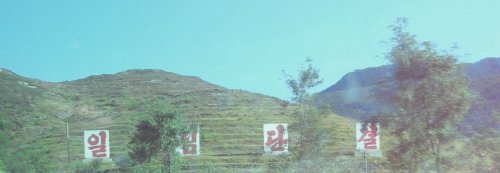
Masses of people walk along the roadside and rail line, coming home from a day of farming. A few hopper cars, loaded with stone, rest idle on the tracks. People in yellow vests cut weeds by the side of the road. Sprawling signs exhorting labor and loyalty spread across the countryside, their red letters standing out against the earthen backdrop. Are these signs “Communist,” or are they “Korean?” Are they different than the moral aphorisms written in stark black calligraphy and hung in South Korean homes and offices?

(Pyongyang 36km) People walk along the side of the highway, crossing in front of the speeding bus, running when the horn blares. A small deer walks across the highway and bounds away into the bushes on the other side.

Ahead, Pyongyang rises as white pillars through the dull haze, a softly-focused image of the Emerald City in the land of Oz. (Pyongyang 12km) So many people still working in the fields. I guess the harvest does not respect days off.

A large solitary smokestack rises to the left, a thin wisp of grey trailing lazily out the top. Further on the skeletal framework of I-beam construction stands, awaiting the workers to add flesh to the building. Ahead, straddling the road, towers the Monument to the Three Charters of Unification.

17 November 2005

Lunch in Kaesong, the Road to Pyongyang

Back on the bus, heading from the DMZ to Kaesong. Farmers having a break, drinking together between the road and the field. A magpie lands by the drying rice stalks. Past the rail line that links the North to the South, a new station being constructed, waiting for those future trains. And we enter Kaesong, population 300,000, greeted by dusty apartment blocks, grey white.

Lunch is in a restaurant where the hanbok-clad waitresses are waiting. This is the traditional Korean meal, a dozen side dishes sitting out (separate for each person, a bit of a deviation from tradition) and a small cup of a rather potent ginseng wine. The conversation flows through innumerable topics as the blushing waitresses stand by, watching their American charges.

Outside again, a brief photo op, the relative freedom of a few moments to stand, walk, watch. At the top of the hill, a statue of Kim Il Sung. At the bottom, a department store, devoid of people. Quickly, quickly, back on the bus. We have a schedule to keep. Our guides are efficient, to say the least. (after the trip, we find that our bus hit more places than some of the other buses, with their slower tourists).


We are off to the Koryo museum, the only taste of “traditional” Korea we see on the entire trip. It is a tour that any second grader would envy – run up to an item, listen to the brief description, move on. No lingering, don’t try to stop and admire, to ingest the ancient celadon pottery, to bask in the pale green, the white inlays. The only pause is at the gift shop. Get your famous Kaesong ginseng. And so we do. And it is back out of what was once an ancient university, past the massive centuries-old ginko trees, and onto the bus.

Laundry hanging out of the apartment windows. Peppers drying on roof-tops. Children out playing by the roadside. Past a set of bone-dry swimming pools. Groups of people down by the shallow stream, washing their hair and clothes. Past the schoolyard, the children playing on faded metal equipment, once brightly colored, now mimicking the rest of the bleakness. The sense of neglect is pervasive, from the empty pools to the pale grey apartment blocks. A layer of dust coats everything, concrete walls chip and flake, color is almost non-existent were it not for the blue trim around the barred windows or the occasional potter geranium, brightening up the balcony.

Spreading out from the city, the mountains rise, some barren, others terraced. The apartment complexes we pass are poorly built block structures, some being rebuilt, the gaping holes filled with roughly shaped block and covered with mortar – no sign of mortar between the blocks. We pass more children playing, others in groups. While there are smiles, there is no sense of the Sunday “holiday.”

(Pyongyang 156km) Children ride by on their bicycles, wearing red jackets with yellow piping on the sleeves. An open military truck rumbles up a dirt road, soldiers standing in the back. Blue buses unload school children on a road paralleling the highway. Even the tank barriers are giving in to the entropy, curved rebar twisting out of the unfinished top, a broken concrete sheath surrounding a hollow core.
A soldier, gun on his hip, holds the gate ajar as we wind through the checkpoint and near the first in a long succession of tunnels on the road to Pyongyang. A jeep by the side of the road, doors open, no passengers in sight. Schoolchildren walk by the side of the highway, shout and wave to our buses, breaking into genuine smiles that seem to only ever be seen on children. They are smiles that are not constrained by racial or ideological differences, but surmount such trivialities. The emit a sense no of depression or oppression, but of kids, looking for fun, seeking new experiences, open and friendly, trusting and no yet jaded.

At this moment, another reality strikes me. The windows of the bus are tinted blue, giving a false sense of green to the yellowness of the landscape. We pass more soldiers, seeming barely more than kids themselves, riding their bikes, their rifles bouncing against their backs as they pedal down the side of the highway.

(Pyongyang 132km) The sun, the food, the walking, the steady road noise as the wheels speed along the pavement, the breeze through the barely opened window, all combine to press on my eyelids, weighing them down, urging a rest. But I can’t stop watching the landscape as it speeds past the window. When will I again visit this land? On a hill to the east of the bus stand three mounds with marble markers, the first set of traditional burial plots I have yet seen in North Korea.
(Pyongyang 97km) A farmer walks slowly along a hillside by the road, tending a flock of white goats. An ox, plowing a field as the remnants of the rice stubble is collected and burned. Tractors are sparse, and were mostly closer to Kaesong; old red Russian or Chinese machinery, oversize rear wheels powering over the harvested fields. And we arrive once again at the rest area.

15 November 2005

All the world's a stage...

Having seen Panmunjom from both sides, the thing that comes most readily to mind is the Shakespeare line, “All the world's a stage, And all the men and women merely players.”


On April 27, 2004, I traveled to Panmunjom from Seoul on a grey and dismal day (see my notes from then, Part I, Part II, Part III, Part IV). It seemed fitting weather to visit such a location. On October 16, 2005 I visited Panmunjom from Pyongyang on a bright, sunny day, an odd juxtaposition to my location. Somehow things were dreary on the democratic southern side and cheerful on the socialist northern side.

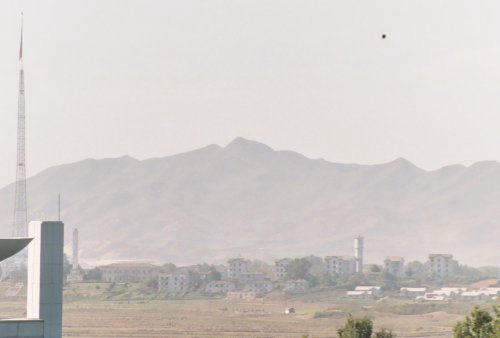
But one thing struck me most after having been on both sides of the little blue buildings. It is a show. The entire location is a stage, and the actors are there simply to flesh out the narration of the guide.

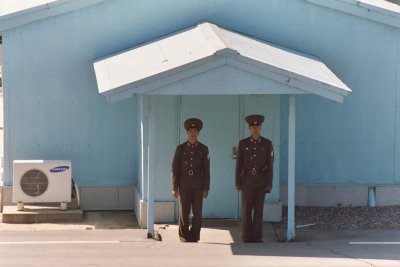
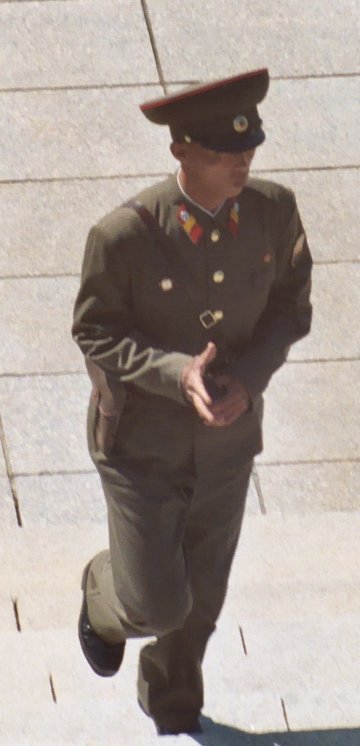
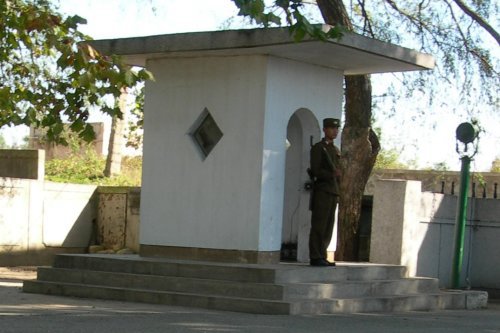
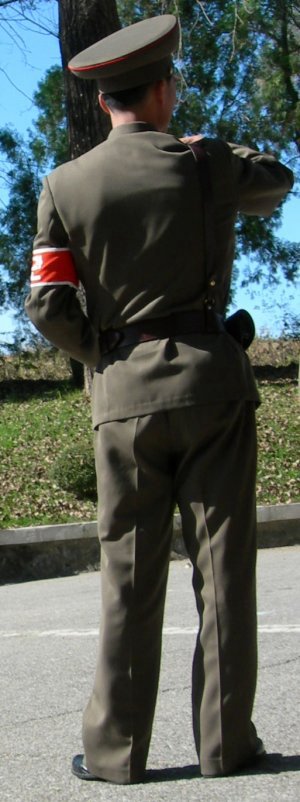
When I visited the southern side in 2004, I was surprised (and dismayed at the time) to see that there were no north Korean soldiers standing toe-to-toe with their Southern counterparts, just a solitary soldier standing in the shelter of a building, out of the damp chilling air. Yet when I visited the northern side in 2005, it was a Sunday, and there wasn’t a Southern soldier in sight, though there were plenty of North Korean soldiers standing guard.

After our brief lecture, we were shuffled away, and as we left I took a last glance at the dividing line – only to see the guards marching off to a building, having stood there simply for our enjoyment. All the world’s a stage...

A few additional, disconnected observations, from my journal...
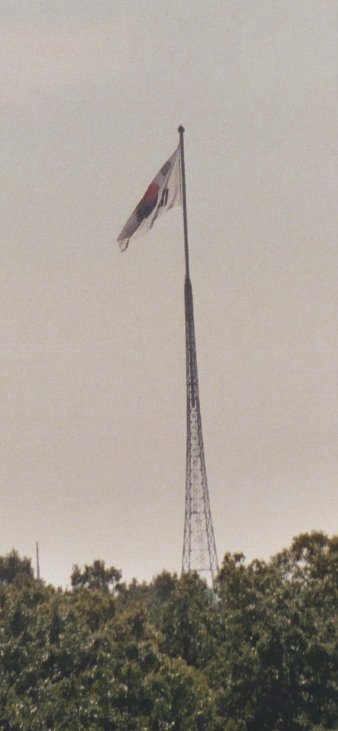
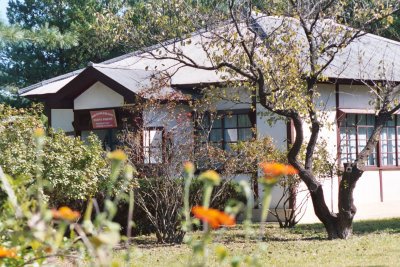
We stand admiring a large representation of the last signature Kim Il Sung ever signed, allegedly on a document dealing with the national reunification as he prepared his Dacha for the planned visit of then South Korean President Kim Young Sam. A member of the tour lingers too long by the signature, seeking the perfect photograph, and a guard steps up swiftly, his heels clapping against the pavement as his hands clap in loud time with his footfalls, urging us on. Inside the marble building on the Northern side, the stale smell of cigarette smoke permeates the cool, dead space; lingering in the stagnant air. Outside the sun shines on the empty buildings, the air leaving the massive North and South Korean flags at the nearby border cities hanging limpid from their towering poles. Nothing stirs.


There is a peaceful calm that belies our location at the center of one of the last remaining flashpoints of the Cold War. It is hard to imagine the firepower not too distant to our north and south. And yet, being an American tourist on a trip from Pyongyang to Panmunjom, it seems little more “real” a chance of war than it did driving there from Seoul. Is it simply a tourist attraction? Will they set up a concessions stand on the line, selling trinkets of the division, like pieces of concrete from Berlin?

04 November 2005

Armistice, Aggressors, Americans, Ambassadors


It is a pleasant sunny Sunday, the air warm but not hot, the sky clear. And here I stand, on the northern edge of the Demilitarized Zone, one of the least aptly named locations in the world. 18 months prior I was standing at the southern edge of the DMZ, well, actually under it in the infiltration tunnel, and in Panmunjom on the Southern side, my only venture into the North inside a small blue building, crossing quickly to the “other” side of the room for a forbidden taste of the workers’ paradise. And now here I am, surrounded by North Korean tourists, soldiers and guards, preparing to head into the DMZ from the “wrong” side.

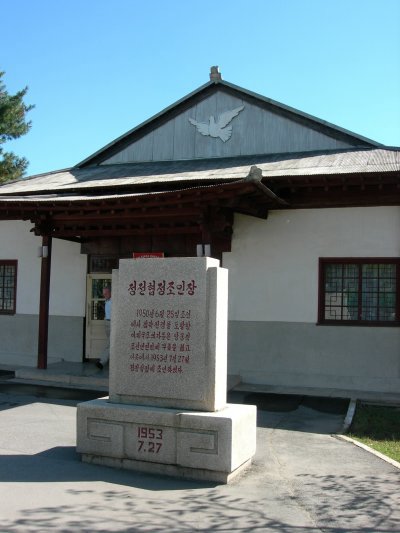
First, we are walked, single file, through the barriers to our waiting (and already searched) bus, our cameraman filming the moment for posterity sake. No photographs please (though if your camera rests at your side, no one can tell...). And we are bused in, past a row of tank barriers, waiting for their shim to be removed so the concrete blocks can slide down the inclines onto the walled-in road. Over the moats, past the barbed wire, and down the road to the buildings where, just 52 years and 81 days prior, the armistice was signed to end the Korean War. As we pull up, we are reminded by our guide that we must remember that there are still U.S. troops stationed in South Korea (implying not so subtly that the occupation continues, as does the threat of invasion).

We are given the history in numbers and dates, as is typical of North Korean history.
June 30, 1951: The U.S. side first suggested armistice talks.
July 10, 1951: The armistice talks begin near where we are standing.
October 25, 1951: The armistice talks moved to the site we are touring.
There were a total of 158 meetings over two years.
The Armistice Agreement was signed at 10AM July 27, 1953.

The general briefs us on the history, and politics. One of the female guides from another bus translates. At certain points she smiles in the way Korean women do when they are embarrassed by what they have to say.

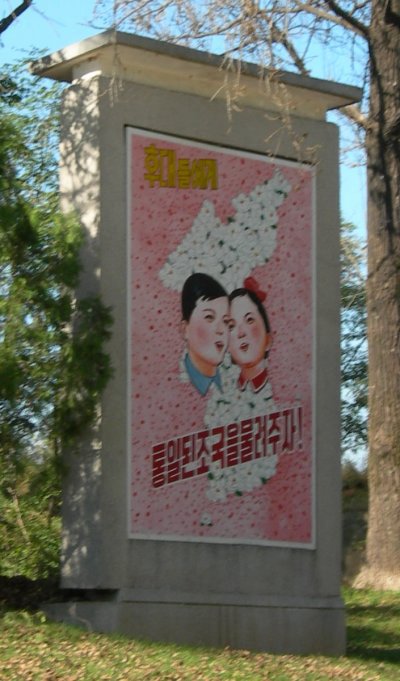
The gist of the talk: Over 50 years many things change, but one thing doesn’t change – the hostile policy of the United States toward the Democratic People’s Republic of Korea. There is no peace in the DPRK due to the military posture of U.S. forces in South Korea. Nobody wants war; they all want to live in peace. But Korea remains a divided country; an unsettled situation – not war, but not peace either. One of the most important reasons to unify the country is because of America. Americans must return to their homes, because Korea is too far away.


The old Korean War propaganda leaflets, depicting American families with messages suggesting that the wives of soldiers are sleeping around while they are far away; too far away. This is what springs to mind. The translator blushes when asked to say American Imperialist Aggressors. The words roll off the tongue of the General, but later he will talk, in heartfelt tones, holding on to the hand of an American, of how there is no desire for war, only a desire for peace, and how it is important for us to build understanding and trust.


Now, a personal aside. I am neither a violent patriot nor one of the myriad Americans who seems to find plenty of time to denigrate their own nation. I firmly believe it is everyone’s right to have and express their opinions. And while I may agree or disagree with some of the actions of my nation, and my government, I will NOT badmouth my country or its leadership in front of others simply to ingratiate myself upon my socialist hosts. I am offended as a free-thinking citizen of the United States of America by the actions and words of some of my fellow travelers. Equally at those who denigrate their own nation to gain points from their hosts and those who harp on to their hosts about how much better things are in America. Neither is called for on this trip. True diplomacy comes from a clear demonstration of principles in action, and from showing respect, or, as our tour arrangers put it so succinctly, at making sure at least not to show disrespect for the hosts. It was our choice to visit, and our responsibility to set such an example that, whatever people may be taught or told, they will be able to remember us and say that, at least from what they saw of us, Americans are not bad, they are people too, and that begins to bridge gaps.

OK, enough moralizing, back to the DMZ...

Yi Sun Shin Goes to the DMZ


OK, a brief break from the DPRK trip for this commercial announcement...

They are going to sail a replica Turtleboat through the part of the Han River that runs through the DMZ. Now, I don’t know if you saw Heaven’s Soldiers, but it would seem that the producers weren all that far off with the idea of pairing Yi Sun Shin with North and South Korean soldiers in 2005 – only this time it is the Turtleboat that travels to 2005, not the Korean soldiers slipping back into the 1500s...

Heaven’s Soldiers from YesAsia
A Yonhap article on the movie

The Road to Kaesong: Part II

As we leave the rest area, we are told we have on hour to go to get to our first destination of the day – the armistice buildings. And so, more time to gaze out the window.

Young soldiers in uniform huddled around a bicycle they are fixing. Female soldiers stand by the side of the road waiting for a ride from one of the relatively frequent green jeep-like military vehicles. (Kaesong – 68km)

I wonder how much the gasoline for this trip costs? Four busses loaded with Americans hurtling down the highway from Pyongyang to Kaesong and the DMZ. Houses whiz by the windows, their walls starting to flake, the tile roofs overgrown with plants, perhaps gourds of pumpkins? We pass through several tunnels, and approach the first of several roadblocks. (Kaesong – 44km)

On the east side of the road we pass some sort of dinosaur museum, a small roadside building looking like any tourist trap along the U.S. highways in the west. (Kaesong – 32km)

A few men sit in a small boat, one stands to throw a net into the water. The mountains pile atop of one another, fading into the distance. There is more vegetation than I expected, having heard that the hills were stripped bare both as scars from the War and by farmers desperate for food and firewood. Not all the stories apply to all the areas. One thing that I recall is that most of the defectors who discussed famine, for example, were from the northern-most provinces. These are the provinces for the politically “unreliable,” and they are geographically the least hospitable for living and farming. Applying their views of the countryside, even if one could take them as completely unbiased in their assessments, and applying it to the entire country would be about as useful as looking at the situation in the mountains of West Virginia and applying it to the entire United States.

As we pass by people by the side of the road, they turn to look at the buses. Vehicles are rather infrequent here. Or is that simply because it is Sunday? The highway looks like a paved-over series of concrete slabs, no shoulders along the edge. The faces of the tunnels are flaking, the concrete cracked. A pheasant flies by in front of the bus, startled from the grasses as we drive by.

The view grows more urban, more houses, some with crumbling walls and unfinished roofs. And this along the main national thoroughfare. Small tile-roofed houses fill the gaps between taller apartment complexes. The grey color pervades all, broken by the bright reds from the flowers growing in pots on the balconies. All while farmers, their bicycles parked by the sides of the fields, roll the rice straw into bundles and piles.

01 November 2005

The Road to Kaesong

Sunday morning, breakfast in the hotel – buffet style. Your choice of toast, eggs, kimchi, oily kim, cake, soup and one cup of coffee (but only if you ask the wait staff). Mulling around the hotel bookshop, no one is there, it is too early in the morning, but as several people walk in and around the book area, a lady comes running up to open her store – obviously called from home to cater to the foreigners and gather their euros, yuan and dollars. But is it service with a smile.

And it’s off to Kaesong. While the guides emphasize that it is a day off, being Sunday, there are large groups of people waiting for the bus – perhaps to visit relatives or go to the park? Several military trucks stacked high with bags of grain pass by in the other direction, as the guide reminds us that in North Korea, it is correct to say “annyong hashimnikka?” rather than the South’s “annyong Haseyo?” As we cross the Taedong River, the Pueblo sits along the banks, a shining trophy to the people of North Korea – and a place we will alter have the opportunity to visit.

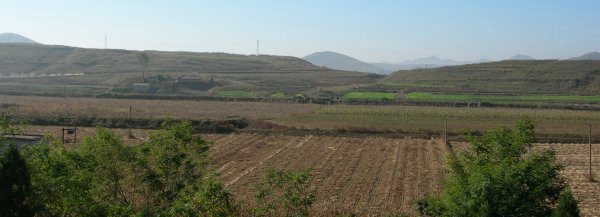
Out the window, the city slips away and we head into the farmlands. Large groups of schoolchildren walk together by the side of the road on a weekend outing. Rice straw is piled in the fields to dry. The guide drones on about reunification policies, and while I am interested, it seems the same old stories from the KCNA and Rodong Shinmun. Ladies work in the fields, gathering straw into bundles, and piling the bundles into mounds. Some grandfathers pick slowly through the stubble, seeking whatever has been dropped.

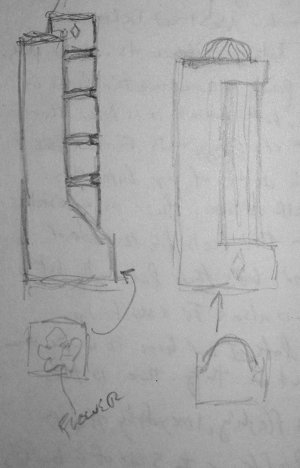
Along the roadside, tank barriers rise like monuments – some even inscribed with patriotic phrases. Far from the dull overpass-style tank barriers in the south, which are wired to fall straight down and block the road, the North’s barriers are pillars, some with flower designs, standing as columns along the apian way, their bases wired with explosives to collapse onto the road and slow any South Korean or U.S. tank formation taking the wide – but mostly deserted – highway to Pyongyang.

The guide seems to slip in his propaganda logic. My ears perk up. It seems there is another logical gap – like Kim Il Sung leading the anti-Japanese militants at the age of 13. In this case, the North Koreans claim the IAEA was trying to wrongly inspect North Korean military installations due to false information that the North was developing nuclear weapons. There was no nuclear weapon program. The next phrase, however, is that Pyongyang developed nuclear weapons to protect against a U.S. invasion. He is adamant to drive home the point that the U.S. unfairly accused North Korea of developing nuclear weapons, and that it didn’t develop them, and the accusations were simply an excuse to vilify North Korea and try to gain access to military facilities.

Now the logic circle starts to come together. North Korea, it appears, only began developing nuclear weapons after the Bush administration abandoned the Clinton-era Agreed Framework agreements.

But enough about that. The guide wants us to remember that the situation now is much different than it was 50 years ago. This tour is about building up understanding and trust. Come, see, listen to what North Koreans have to say. Use your own judgment. Build up trust. The most important thing is understanding, and then building trust based on understanding. This is obviously the message he was asked to drive home. Shortly hereafter, he allows us to take pictures outside the bus windows at the passing countryside.

But apparently there isn’t understanding even between the guides, because as soon as the cameras come out, our political minder in the back of the bus rushes forward and shouts at us to stop, to put away our cameras, and to take no pictures from the bus.

So it is simply visual observations, and my pencil flies over the pages of my rapidly filling journal. We pass by Sariwon, a provincial city in North Hamgyong Province. It is overgrown with rusting construction cranes, like trees petrified in time, not moving, and apparently incapable of moving even if there was a plan to get them going. There are half-build buildings, apartments and housing from the looks of it.

An ox cart, drawn by an emaciated ox, his ribs creasing his leathery hide, carrying sacks of grain. Several men carry piles of corn stalks on A-frame packs. Groups of people harvesting rice in the fields, others cutting the old stalks. Manual labor, a clear drop in standard of living from Pyongyang, but there is something very similar to being in the southwest of South Korea, where there is still farming done by hand, and families working small plots of land. The biggest difference is the oxen, yoked to a plow, rather than the two-wheeled roto-tiller tractors seen in the Southern fields.

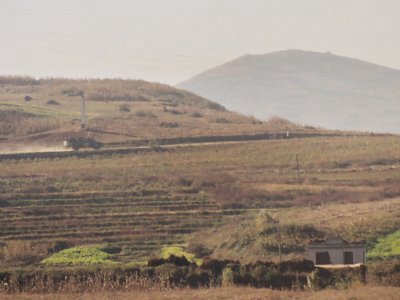
Mounds of cut rice stalks mimic the mountains surrounding the village. The mountains rise steeply, rock-strewn faces, vegetation failing to find a foothold in some places. Wherever possible, hills and mountainsides are terraced in wavy patterns of light and dark bands. Small thatched huts, raised on stilts, sit by the edge of fields, places for a break and perhaps a drink. And up ahead, spanning the highway, is the rest stop.