28 February 2006

Beijing Rolls Out New Technology in War Against Spitting People

Beijing has been ramping up its anti-spitting campaign for quite a while now, but there is a particular earnestness as the 2008 Olympics near. Chinese authorities want to clean up the image of the city, and having tourists and Olympians seeing everyone from the factory worker to the grandmother to the petite young college coed hocking up big lugies is not the image of a refined 5000-year-old civilization China wants to present.

Now, the signs and advertisements pleading with residents to stop spitting have amounted to nothing. Perhaps it is because the air in Beijing is un-breathable, and the only way to not choke to death on the morning commute is to continuously expectorate. Or perhaps it has just become an element of the local culture – New Yorkers are rude, Beijingers spit.

But Beijing is now going high-tech in the War Against Spitting People (WASP), deploying a $125,000 camera-equipped vehicle capable of catching spitters on tape day or night, and thereby giving enforcement officials all the evidence they need to guarantee the offenders have to fork over the $2.50 fine. After 50,000 spitters fined, they will have recouped the vehicle cost (not counting operation, maintenance, tapes, fuel, salaries of officers...).

And they are off to a good start. On the first full day in operation on the Dongcheng District Feb. 24, after a 10 hour operation involving the crew of the surveillance vehicle and beat cops, they had caught a total of NINE evil, vile, Communist spitters (oh wait, they are all communist...). At that rate, they will capture and fine enough spitters to repay the spit-mobile in just 5555 and a half days, or just over 15 years.

23 February 2006

China Altering Perceptions of KMT?

There is an interesting comment over at Bingfeng Teahouse about changes in the pop media portrayal of the KMT in China. Rather than treating Taiwan's Nationalist Kuomintang (KMT) like a traitor, opponent or other problem, the shows portray the KMT as a co-fighter of the Japanese with the Chinese Communists.

This sort of subtle manipulation of popular sentiments was seen in South Korea, with the 1999 release of The Spy, and moving through other movies like Swiri and JSA; all of which altered impressions of North Koreans, from being evil to being figures deserving at least of sympathy.

For Beijing, this is part of a broader campaign to undermine Taiwan's ruling Democratic Progressive Party (DPP) and to portray a pan-national sense of "Chineseness," that draws on all ethnic Chinese (Taiwan, Singapore, Indonesia...) to build up a greater China rather than having arguments within the Chinese community.

Instead, Beijing uses Japan as its foil, something Japanese Prime Minister Junichiro Koizumi seems ever willing to assist with through his Yasukuni visits.

This is designed to keep Taiwan from going too far down the independence road and encourages economic and technological cooperation with ethnic Chinese throughout East Asia and the world. And contributing to this lofty goal are the subtle changes in public perception due to popular television.

Dawson, Condemnation, and History

There has been plenty of talk in Korea and in the expat and foreign blogs watching Korea over the claims by a Pusan man that he is U.S. skier Toby Dawson's biological father. One main issue raised by western observers is that they would never have simply abandoned the search for their lost child, and they cannot see how someone would not have gone to the police. The self-claimed father, Kim Jae Su, told reporters "I didn't think reporting it to the police would be of any help, so I went around looking for him myself."

While it is hard to fathom now that someone wouldn't go to the police to find their lost child, one must look back at that time in history. Through the 1970s and into the 1980s, the police in Korea were not approachable for "little problems" like lost Children. They were tools of an autocratic and militant regime, and a source of enforcement, not a source of assistance to the "common man."

I know of other, much less public, figures (relatives included) who were lost as children, and their parents didn't go to the police. The police wouldn't have helped even if they had shown up. In one case, it was more sinister than being taken to an orphanage - the young girl was picked up by a lady recruiting for a brothel. Luckily, she was a well known little girl in the neighborhood, and was seen and her father was able to recover her before any harm was done.

This is a sad story, but it is a reflection of the significant difference in social and cultural norms in Korea in the 1970s and even into the 1980s. Remember, the Kwangju massacre occurred in 1980, just a year before Kim Jae Su claims to have lost Toby Dawson. This was not an open and friendly regime, and police were not the servants of the people.

The 1988 Olympics in Seoul ushered in some internally enforced political and social change, the Asian economic crisis in 1997 brought in more. But it has been just a quarter of a century since South Korea was deploying paratroopers against its own citizens in ChollaNamDo, and it was in this atmosphere that Mr. Kim claims he lost his son and didn't turn to the police.

I make no justification for Kim, nor do I have an opinion one way or another as to whether Dawson is his son. But there is a distinct holier-than-thou attitude among foreign observers that fails to understand the reality of daily life in South Korea 25 years ago, and if one forgets to look to history, one is doomed to repeat its mistakes.

21 February 2006

Our House, In the Middle of the Sea...

Kim Sung Do and his wife Kim Shin Yul, 66 and 68 respectively, moved into their new home on Tok-do Feb. 19, nearly 10 years after their previous home on the disputed islet was wiped out in a storm. The new home is part of a $1.75 million reconstruction project on the rocky outcroppings funded by the Ministry of Maritime Affairs and Fisheries (MOMAF)that also included upgraded port facilities.

The two Kims, who have been living on nearby Ulleung-do for the past decade, will reportedly be sharing their island with poet Pyung Bu Kyung in April, according to Korea.net.

The return to Tok-do comes a week before a group of motorcycling students embark on a 23 nation eight month tour of the world promoting Korea's sovereignty over Tok-do. The so-called 2006 World Cross Project Dokdo Rider, which has yet to activate the English language part of its website, will travel first to California March 1, and during its travels will spend time in Germany for the World Cup. A noble excuse for a rather extensive college road trip, apparently.

All the rush to remind the world that Tok-do is Korean territory (despite the fact that no one asked) is due in part to the fact that Feb. 22 will be the first Takeshima Day, as designated by Japan's Shimane Prefecture last March. Shimane's prefectural assembly decided that, as 2005 marked the 100th anniversary of Japan's claim of sovereignty over Takeshima (as Japan calls Tok-do), they would create a day to memorialize the ownership (and yearly annoy the Koreans). Thus South Korea made sure its civilians moved back out to Tok-do before the first Takeshima Day, and the Dokdo Rider group is getting additional publicity.

Of course, this raises another important question: if Tok-Do is in the East Sea and Takeshima is in the Sea of Japan, why is everyone arguing?

16 February 2006

And In This Race, Little Kim, Fat Bear and JC...

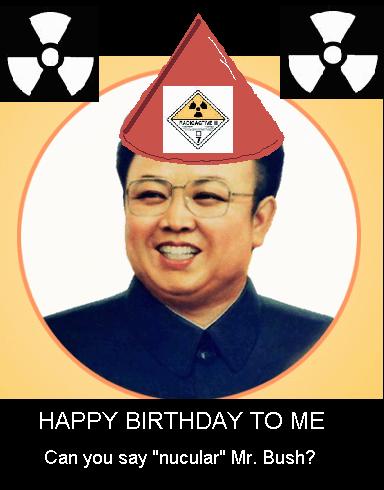
Kim Jong Il prepared to celebrate his 64th birthday amid the strains of the Rakhmaninov's Piano Concerto No 2 and the eternal classic March of Songun Victory performed by the central military band of the Defense Ministry of Russia on their visit to Pyongyang. Kim also basked in the near universal international media speculation as to which of his kids will succeed him.

And this made Kim smile.

First, by hanging with the Russians the night before his birthday he could aggravate the Chinese, and remind Beijing that North Korea, while certainly a neighbor and often a client, was not about to relinquish control over the six party talks and simply give in on the U.S. counterfeiting charges.

Second, by keeping any real plans for succession under wraps, Kim could keep international attention on himself, and stoke the sense of uncertainty that ensures Beijing and Seoul both see it in their best interest to protect the North Korean regime from potential military "adventurism" by the United States.

The succession talk is all the rage amongst us remaining (and some newly emerging) Pyongyangologists, as it is our holy grail; to be able to predict the future of the North Korean regime.

In some sense, it is not a hard process. There is a general agreement that Kim will pick a family member as his successor (this, of course, assumes that there is a conscious decision here, and that some wildcard uncle, brother-in-law or colonel doesn't simply step in a take power). There is also a general agreement that Kim has only three viable sons for the job. This makes the odds of an accurate guess pretty close to 33 percent.

Add in that the youngest son, Kim Jong Un, despite being reported as a mirror image of his dad (belly and bouffant included), is but a young 22, and therefore, although he wears the technicolor dreamcoat of a favorite younger son, little Kim is unlikely to supercede his brothers.

Now the odds are down to a much more even 50/50.

Here things get more interesting. On the one hand, there is the shame of the family, the carrier of the "Fat Bear" passport, Kim Jong Nam. In 2001, he apparently thought his future was secure, and when asked what he would do when he succeeded his father, he retorted "I'm going to Disney World." While the retort is only speculation, his 2001 deportation for Tokyo seems much more certain. Looking more like his (still respected) grandfather, Kim Il Sung, Kim Jong Nam is the oldest of the possible successors, and therefore, dynastically speaking, should have been next in line. Current reports from "the experts" say Fat Bear has made up with daddy, and is back in the running.

The current favorite amongst the odds-makers, however, is middle child Kim Jong Chol, who, from the few existing photos (if they are really him) looks like he would be more at home on the DDR machine than running the DPRK. But "JC" was also rumored to have been at the table with his dad when the elder Kim hosted Chinese President Hu Jintao in 2005 in Pyongyang. There are mixed views on this dinnertime exposure (Kim was showing off his next in line, or Kim was showing the Chinese that he still controlled North Korea's political destiny), so the jury is still out, but that is what makes this so fun.

Now, between Fat Bear and JC, I would lean toward JC, but I am partial to middle children. And Kim Jong Il is clearly cognizant of all the international speculation over his kids, and may well be stoking speculation to keep everyone guessing. After all, he is the king of obfuscation, and ambiguity remains his best tool in the international arena.

So its 55 percent JC, 43 percent Fat Bear and 2 percent Little Kim. And plenty of percent chance that all of us "watchers" are being led on by interests inside and outside (or opposing) the regime.

14 February 2006

It Is Almost Time

Just a few more days until the Dear Leader's Birthday, and, if North Korean media is to be believed, the whole world is preparing for a very respectful party. Sae hae chukha hamnida. Only a few more years 'til retirement age...

12 February 2006

Seoul: Looking South for Help North

South Korea and Vietnam have signed a deal to cooperate on intelligence issues and set up mutual liaison offices in each others' countries. The agreement is not all that amazing, but it does reflect South Korea's increasing use of Southeast Asian nations for assistance in dealing with the North.

In 2002, Seoul announced plans to upgrade Vietnamese military equipment, a move designed not only to benefit South Korea's defense industry, but also to enlist Hanoi's assistance in restarting stalled inter-Korean talks. A 2003 meeting between the South Korean and Vietnamese Prime Ministers led to increased business cooperation (and there was a brief jump in Vietnam settings for South Korean movies and TV dramas). And in 2005 the two nations signed a bilateral trade agreement.

Pyongyang and Hanoi have relatively close historic relations due to similar past ideologies, of course, and North Korean pilots flew on the side of the North Vietnamese during the Vietnam War. But Vietnam also saw troubles with the North in 2004, when it ultimately allowed some 460 defectors passage to South Korea. Pyongyang reportedly withdrew its ambassador to Hanoi at that time. But relations between the two have recovered somewhat since then.

Now Seoul is enhancing intelligence cooperation with Hanoi, and continues to increase economic contact, particularly in the energy sector, with South Korean firms drilling offshore Vietnam. But Seoul is not only working through Hanoi. When relations between Pyongyang and Hanoi soured, Seoul turned to Indonesia, which is currently working to facilitate military dialogue between the two Koreas.

As Seoul looks for more control over its relations with the North, and tries to pull out of the U.S. shadow, it is enlisting nations that have little reason to try to overshadow Seoul or usurp its position. South Korea will still work with the United States, China and even Russia and Japan, but given the vested interests of those nations, the benefits of Southeast Asian facilitators is obvious.

10 February 2006

North Korea: Crossing a River Blind

China's official People's Daily online edition ran an article in the Opinion section Feb. 9 about North Korean leader Kim Jong Il's recent visit to China. The article, titled "Opening up" message revealed by Kim Jong Il's China visit, was republished from the Communist Party of China magazine Ban Yue Tan (China Comment) and written by Ren Libo, the magazine's reporter in Pyongyang.

It is mostly predictable in its content, highlighting Kim's recent and previous visits to China (dating back to 1983) as exploratory trips to discover and study economic examples that could be applied in North Korea. The article does, however, point out that Pyongyang has had to adapt economic programs to North Korea's conditions, and adds that "The introduction of market and competition mechanism, however, can trigger problems such as social wealth gap and inflation."

In the end, it concludes North Korea is cautiously moving forward with reforms, though the analogy it uses - that of one "gropingly crossing a river" or "one with internal hardship and toughness outside" - add a cautious note. This is not a glowing review of North Korean reform efforts, or even a praise for Kim's trips to China. Instead, it paints a dangerous path North Korea's leadership is treading, like people stumbling from slippery rock to slippery rock across a rushing river, all while blindfolded.

It is interesting that an official Chinese Communist Party magazine, with a Pyongyang-based reporter, produces such an open and not-entirely-reassuring picture of North Korea and its leadership. It is an altogether more realistic assessment (at least in the final analogies) than most others I have seen, and raises a very interesting question: is China concerned that North Korea will fail in its experiment? Is this Beijing raising a warning flag, or trying to pressure Pyongyang to pay more attention to China's guidance?

Either way, there is a clear note of caution and a sense that, even from big brother China's perspective, North Korea is facing some tough times ahead, and instability may be one tiny slip away.

09 February 2006

TV Dramas Pave Way for Footballer

Korea is making a big deal about Pittsburgh Steelers wide receiver Hines Ward, as he is a Korean-American. They are also making a big deal about the fact that they are making a big deal about a Korean-American. Korean companies are falling over themselves to get a piece of Mr. Ward, who is tentatively planning an April visit to Korea.

Mr. Ward may owe his reception to changing attitudes and to Korean MBC dramas. Two recent ones, Sweet Spy [Dalkomhan Seupai] and My Name is Kim Sam Soon [Nae Ireumeun Kim Sam-soon], both prominently features Korean-American actors, Dennis O'Neil (AKA Dennis Oh) and Daniel Henney respectively. Their inclusion in the dramas helped eliminate some of the stigma around the "halfs," or perhaps the stigma was lifting, and that paved the way for the dramas.

Either way, there appears a shift in attitudes, or at minimum a healthy dialogue. And that may make things easier for my son, who perhaps can follow in O'Neil and Henney's footsteps and end up on TV.

05 February 2006

North Korean Trade

A few numbers on North Korean trade from KITA.

Bilateral trade between DPRK and PRC
2005: $1.58 billion (up 14.8 percent)
2004: $1.39 billion (up 35.4 percent)

Bilateral trade between DPRK and ROK
2005: $1.06 billion (up 51.1 percent)
2004: $697.04 million (down 3.8 percent)

Bilateral trade between DPRK and Japan
2005: $139 million (down 22.9 percent)
2004: $251.87 million (down 4.8 percent)

04 February 2006

Tanks for the Memories...

With the New Year festivities winding down, it is time to restart the diplomatic agenda. North Korea and Japan meet in Beijing this weekend, South Korea and North Korea are preparing for a renewed round of general-level military talks, and Indonesia is sending an envoy to Pyongyang and Seoul to facilitate ministerial level defense talks. Former South Korean President Kim Dae Jung is working toward a train-ride to Pyongyang, and U.S. President George W. Bush refrained from any major condemnation of North Korea in his State of the Union Address the other night, making officials in Seoul smile.

Happy New Year.

There are other sign of spring - the tank barriers are coming down along the invasion corridors of South Korea. These massive concrete beams resting on pillars over major (and not so major) north-south roads were erected to avoid the little mishap of June 1950, when North Korean armor rolled unchallenged down the roads to Seoul. (That is not to say that there weren't noble acts and creative solutions - like martyr soldiers running into the armor to place satchel charges, or sticking explosives wrapped in a tar-covered sock to the sides of tanks.)

Over the years, North Korea's tank force appears more embedded in concrete as part of a defensive wall than any sort of tip to an offensive spear. And South Korea is better armed than it was before. Gone are the days when southern forces are left with minimal firepower, no anti-tank mines and only a few small and ineffectual bazookas.

With the current IMINT capabilities, gone too are the days when an armored column could simply sneak across the border. The barricades - wired to explode and send the several ton concrete blocks slamming onto the road below, making it theoretically impassable - are mere remnants of an older era of warfare. Vaguely reassuring shadows of an outdated strategy established to atone for a failing defense that was ill equipped and ill prepared to face the Northern invasion.

In the North, the tank barriers are different - less imposing perhaps, more decorative. The southern barricades appear as some sort of oversize child's building blocks, stacked as a bulky gate over the road. The Northern counterparts are instead series of pillars with slightly narrower bases, wired to explode and send the monolith (and its three or five counterparts) falling over onto the road. They are decorative at times, with bas relief flowers or revolutionary slogans. They do not hang over the road, but stand on either side, a column of silent sentinels awaiting their orders to lie down.

But while there is an active effort to remove the barriers south of the DMZ, time, nature and neglect are taking care of the Northern counterparts. In some cases, the rebar can be seen protruding from the crumbling concrete. In others there appear to be holes, and parts of the concrete pillars hollow. These are not in the middle of cities like in the South, but out in the countryside, along the main highway from the border to Pyongyang.

There are no people to complain about the eyesore nature of the defensive blocks, nor are they really as much as an eyesore in the image-conscious North as they are in the more form-follows-function South (at least as of the time they were built). But they are crumbling. And so is the sense of impending war.

North Korea, once the hottest spot for triggering another global war, is losing its image of formidability. Like an aging prize fighter up against the ropes, there are still clear signs of former greatness; there is still an air of the indomitable spirit and the unflinching confidence. But it is tinged more with the musty smell of nostalgia than with the pungent odor of fresh sweat.

The unanswered question, the wildcard that keeps the bookies in business, is whether North Korea has one more trick, one last feint, whether Pyongyang is really tired out, or whether it is simply playing rope-a-dope with the rest of the world. All signs point to a true fading of spirit, a real decline in capabilities and even a dissipation of desire. But the most dangerous moment in any fight is when one grows complacent with ones opponent. And while things appear to be nearing the end, never let down your guard until the bell rings and you are safely out of the ring.