28 April 2006

Happy 461!

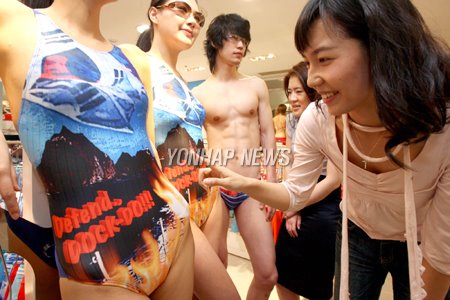
Happy 461st Birthday to Yi Sun Shin! [or is it yesterday... never can tell with that Lunar calendar...] Perhaps we should get him a new Dokdo Speedo? (How did they spell Dokdo wrong? "Dock-do"?!?!)

FYI - Picture is from Yonhap (if you couldn't tell from the big "YONHAP" written across it. The caption with it was
Dokdo-defending swimsuits
April 27, SEOUL, South Korea -- Models sport swimsuits emblazoned with a sign reading, "Defend Dokdo," at a department store in Seoul on April 27. Dokdo is a group of rocky South Korean islets in the East Sea that are also claimed by Japan.

21 April 2006

Tokdo: Roh to Wag the Dog?

For anyone who has been following the latest Tokdo saga (Japan's planned oceanographic expedition and South Korea's rather vocal and nautical response), there is at first glance nothing new here. Japan and South Korea remain cantankerous over the Tokdo-Takeshima dispute, they toss words, deploy ships and fly aircraft. But there is something a little odd this time around upon closer examination. Japan seems a little too swift to give in. It has postponed the survey (weather may have played some roll in that) and is sending diplomatic officials to Seoul to assuage the South Korean ire.

Why, one may ask, is a Japanese government that makes trips to the Yasukuni standard protocol and waves the visits in the face of the Koreas and China now going and doing damage control on an oceanographic survey they KNEW would rile Seoul and trigger a South Korean response? It appears that Japan underestimated Seoul's anger – or more accurately underestimated how far South Korean president Roh Moon Hyun may be willing to take the tensions this time.

Roh is a lame duck president. First, the five-year, no VP, no repeat term South Korean presidential system effectively creates lame ducks as soon as mid-term parliamentarian elections are over. Add to this the deadlock in the six-party talks, the increasing U.S. pressure against Roh's push for greater economic integration with the North and the domestic opposition to the Free Trade Agreement and Roh is really not doing too well. One doesn't even need to look at polls to understand Roh's condition.

So Roh has not backed down in his decrying of the Japanese expedition. In fact, he has hinted at going beyond diplomatic rhetoric. While he has not really said just what he may plan to do beyond a few swift criticisms and perhaps a chewing out of the Japanese ambassador, Tokyo is apparently getting wind of a more concrete offensive – and the fear is that Roh may be hoping the Tokdo tail wags the Korean dog in order to re-invigorate Roh's mandate. After all, who can spend time criticizing or second guessing Roh when all are equally incensed at the Japanese "aggression" going on in the East Sea (east sea, mind you, not the Sea of Japan)?

12 April 2006

Priorities Outlined at the SPA Session

While North Korea's Supreme people’s Assembly (SPA) sessions are usually somewhat dull and predictable, there are some interesting points from this year's opening (Apr. 11, 2006). North Korea has laid out several priorities for the coming year, as well as the current and next five year plan.

"The main task to be tackled in the economic work this year [is] to decisively increase the agriculture production for satisfactorily solving the food problem of the people..."

The various speakers placed emphasis on agriculture several times, both in hailing the increase in agricultural production in 2005 (which, not coincidentally, contributed to Pyongyang deciding to change its relationship with international food donors) and in calling for another increase in 2006. According to the reports, North Korea spent 32.5 percent more on agriculture in 2005 than in 2004, and will spend 12.2 percent more in 2006 than in 2005 (though no base number, nor percent of overall government expenditures, was given for agriculture. The only semi-concrete number given for expenditures was that the military in 2005 and in 2006 gets 15.9 percent of total budgetary expenditures). When discussed, agriculture takes first billing, is to be treated on a "preferential basis" and even gets major billing in discussion on scientific advancement, with calls for bio-engineering and new double-cropping methods. There is also a plan for developing new fertilizer plants using coal gasification as the feedstock.

The second priority is in mineral and resource extraction, including coal and metals. Coal, metal industries and rail transport as a whole will see a 9.6 percent increase in allocated expenditures over 2005. Pyongyang noted a 10 percent gain in coal output in 2005, and plans to "radically bolster up [sic] coal and metal production" in 2006. In the field of science and technology relating to resources, Pyongyang highlights the "latest technology developed and introduced into the prospecting of underground resources" and urges "big efforts" to "industrialize the method of producing iron with locally available raw materials, build a large-scale fertilizer industry based on coal gasification, develop the technology for oil exploration and processing to pave a wide avenue for developing the chemical industry and mine and process on the basis of up-to-date technology such underground resources abundant in the country as lead, zinc, magnesite, graphite, silica and building stone." This is all about exports and heavy industry.

A third priority is in energy. The presenters cite an 11 percent increase in energy production in 2005, and urges the country to speed up "in a big way" domestic fuel and power sources, modernize existing power stations, research renewable energies like wind and bio-energy, expand he use of energy-efficient devices and better manage the nation's energy. In addition, there is the previously mentioned planned development of oil exploration and exploitation technologies.

A fourth priority is in advanced technology, particularly in the IT field. In fact, while the previous three are mentioned prominently throughout the various SPA presentations, the overall "development of science and technology" is listed as one of the three agenda items for the SPA session, after the review and plans for the Cabinet and the review and plans for the budget. While science and technology only see a 3.1 percent jump in budget allocation in 2006, there are plenty of ambitious goals. The speakers "stressed the need to intensify the scientific and technical revolutions as required by principles of the IT age in the new century." Science and technology is supposed to solve the agricultural issue, the natural resource issue and the energy issue. It is also supposed to lay the backbone for a nationwide information network that, coupled with focused education, will turn North Korea into "a power in software development." There are also proposals to create high-tech "hub" cities, where scientists can concentrate and train, conduct research and develop new technologies in intellectual communities under state sponsorship.

While these are the core priorities, there are other interesting bits to note.

First and foremost is he repeated emphasis on the need to expand exports, find new export markets, integrate economically with "overseas Koreans" and others and create various JVs to increase he flow of technology into North Korea and to adapt to the "the changed circumstances and realistic demand." This need for international economic cooperation and trade is repeated several times, and fits with the economic experimentation Kim Jong Il has mandated with the loss of North Korea's former economic sponsors.

On the social front (which will see a three percent increase in expenditures over 2005), there is attention paid to increasing food supplies (perhaps the top priority), the mention of a "new social insurance payment system by enterprises" (unclear exactly what it is, but apparently a nice way of saying heavier taxes on businesses), a "popular policy of health care," and "improving services for the people and bolstering land upbuilding and city management as the householder responsible for the people's living," an apparent reference to a new housing policy, and perhaps the completion and upgrade of half-completed housing projects that dot the countryside all around Pyongyang.

In general, the new plans call for a long-term building up of North Korean infrastructure, technology and social services through the use of foreign assistance and interaction. It is simply a very generalized roadmap to fulfill the economic experimentation that the nuclear crisis was supposed to pave the way for. The question, given North Korea's snail-like ability to alter its plans and course, is whether Pyongyang intends to try this out in spite of the unresolved nuclear crisis, or if Pyongyang is signaling that it will resolve the nuclear issue so as to get on with its new economic strengthening. And given the current opinions in Washington, it would seem that North Korea has but a few weeks or a few months at best to make that decision.

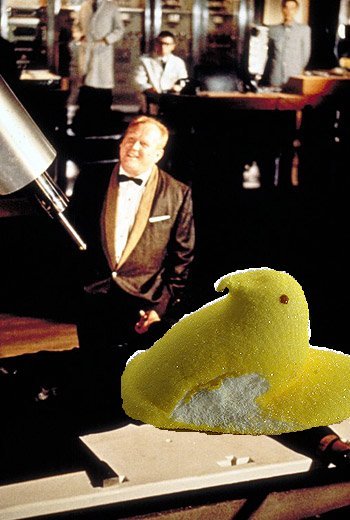
And Now For Something Completely Different...

"Do you expect me to talk, Goldfinger?"
"No Mr. Peep. I expect you to die."

10 April 2006

The General Visits the Troops

Foreign media has noted (somewhat ominously) that North Korean leader Kim Jong Il has paid three visits to military posts this month. As a review of the year thus far, Kim has made more public appearances at military venues than all other visits combined (if the trip to China is counted as a single appearance).

Many of Kim's unit inspections were timed to protest the annual USA/ROK Foal Eagle and RSOI (Reception, Staging, Onward Movement and Integration), in late March. In the days leading up to the exercises and into the early days, Kim visited facilities on March 19, 21,22,23,24 and 25. With the level of internal political rhetoric, Kim's visits underscored the sense of embattlement at home. They do little for external audiences unless the foreign media decides to play them up, which they occasionally do when they are stretched for stories or want to add drama to an otherwise dull day in Asia.

A brief look at Kim's public visits this year show 15 visits to military facilities in 14 different days through Apr. 9, two visits related to science and education, four attendances at cultural or entertainment venues, four tours or field guidance trips to economic, infrastructure or construction projects, and a week-long visit to China, where Kim toured several different factories and economic venues.

Kim's emphasis on the military is necessary as he ponders his next moves on the economic front. If he chooses to abandon the six-party talks, setting back his economic experiments, he will need to heighten the sense of embattlement at home, and thus will play up the role of the military, which train "in the spirit of hitting all enemy targets with burning hatred for the U.S. imperialist aggressors, the brigands."

There has been a clear signal from Washington that the time for talks is running out, and that Washington will simply abandon the six-party process within a few months if North Korea doesn't take concrete steps to at least disclose its nuclear facilities, which would pave the way for the planning of a way to verify the closure if not destruction of the facilities. But even if Pyongyang does make the list, it is not entirely sure the current U.S. administration will offer any incentives to the North, nor that the administration will be able to follow through on any promises it may make, given the fact that the president cannot run for another term and the Republican Congress is looking shaky and distant from President Bush.

On the other hand, if Kim decides to jumpstart the six-party talks as a means to accelerating his economic experiments, he will need to make sure the military remains loyal, and the population continues to see the centrality of the military, and not look for alternatives. Kim continues to fear a North Korea faced with localized protests and unrest as seen in China, and North Korea cannot absorb the social backlash nearly as well as China can.

Kim's public visits this year are listed below. More details are available at Where is Kim Jong Il 2006.

January 4, 2006: Visited the new e-library and gymnasium at Kim Chaek University of Technology.

January 6, 2006: Met Ku Tae Hong and Kim Hyok Il, six-year old boys of rare talent in calligraphy and painting, from the Ponbu Kindergarten in Sinuiju City.

January 6, 2006: Watched the performance "Blue Sky over My Country" given to celebrate the New Year.

January 10-18, 2006: Paid an unofficial visit to the People's Republic of China, with visits to Hubei Province and Guangdong Province, including Wuhan, Yichang, Guangzhou, Zhuhai and Shenzhen, and meetings with Chinese president Hu Jintao, NPC Chairman Wu Bangguo and Premier Wen Jiabao, among others.

January 27, 2006: Inspected KPA Unit 932.

January 28, 2006: Saw a performance of "Blue Sky over My Country" given at the Pyongyang Indoor Stadium on the occasion of the lunar New Year.

February 4, 2006: Visited several sites in Kanggye City, including the Kanggye Wood Processing Factory, the Kanggye Koryo Medicine Processing Factory, the Jagang Provincial Branch of the Central Bank and the Hungju Chicken Farm.

February 6, 2006: Inspected KPA Unit 1687.

February 15, 2006: Saw a performance given by the central military band of the Defense Ministry of Russia.

February 17, 2006: Enjoyed a performance given by the State Symphony Orchestra.

February 23, 2005: Inspected KPA unit 120.

February 24, 2006: Inspected KPA Unit 226.

February 25, 2006: Gave field guidance to the Munchon Kumgang Smeltery.

March 2, 2006: Inspected KPA Air Force Unit 991 honored with the title of O Jung Hup-led Seventh Regiment.

March 2, 2006: Inspected KPA Unit 1522.

March 3, 2006: Provided field guidance to the new facilities in Samjiyon town, including the Samjiyon Children's Palace, the Samjiyon County House of Culture, the Sports Village in Mt. Paektu area, and the newly-built Pegaebong Noodle Shop.

March 5, 2006: Provided field guidance to the construction site of the Samsu Power Station.

March 19, Inspected the forward commanding post of KPA Unit 851.

March 21, 2006: Inspected a women's sub-unit of KPA Unit 824.

March 22, 2006: Inspected sub-units of KPA Unit 604.

March 23, 2006: Inspected the Command of Air Force Unit 435 of the KPA.

March 24, 2006: Inspected Unit 236 for Training Recruits of the Air Force of the KPA.

March 25, 2006: Inspected KPA Unit 3406.

April 5, 2006: Inspected an artillery company of KPA Unit 821 situated on the front.

April 6, 2006: Inspected a three-revolution red flag women's company of KPA Unit 292.

April 9, 2006: Inspected the tank and armoured car drivers training sub-unit of KPA Unit 604.

05 April 2006

China Tries To Kick-Start Korean Nuke Talks

Beijing is trying a last push to restart the six-party nuclear talks ahead of president Hu Jintao's visit to Washington. Chinese Defense Minister Cao Gangchuan is in Pyongyang (and will visit Seoul as part of his multi-nation tour which also includes stops in Vietnam, Malaysia and Singapore), Chinese Foreign Ministry spokesman Liu Jianchiao said at his bi-weekly press conference that "resumption is in the hands of the DPRK and the U.S.," and Chinese representatives will be part of the annual Northeast Asia Cooperation Dialogue (NEACD) seminar in Tokyo where North Korea, South Korea, Russian and U.S. representatives will also attend.

For Beijing, there is little room for major steps on the yuan or trade balance issue, and Hu wants to have something to pull out in Washington to at least attract the attention of Bush. But perhaps more importantly, China sees this as the last opportunity to restart the stalled talks, as Washington has made it clear that, barring progress this spring, talks are off and the follow-on plan (what little there is of it) will be minor needling on economic and human rights issues and other harassment tactics. This makes North Korea neither a valuable card for China to play in relations with the united States nor a state with much chance to move toward at least a moderate economic restructuring, leaving Beijing to maintain the life-support for its increasingly tumor-like neighbor.

02 April 2006

Look! Up in the Sky!

North Korea every month lists the number of "cases of aerial espionage against the DPRK" by the "U.S. imperialists." The latest monthly total was more than 180 cases, including flights by "U-2 and RC-135 ...for intensively spying on major strategic targets and military installations," RC-7B and RC-12, and, "from Mar. 25 to 31 ...an overseas-based E-3 ...on a mission to command more than 2,000 fighters involved in "RSOI" and "Foal Eagle" joint military exercises for aggression and [to] spy on the areas of the north."

As these are pretty standard monthly reports (which international media seems to forget every month that they reprint them as if there is an imminent crisis), I thought I'd just append some links to see and read about the aircraft in question.

U-2
RC-135 Rivet Joint
RC-7B
RC-12
E-3 Sentry