There were only infrequent attempts to link Olympic sponsors or companies producing in


There were only infrequent attempts to link Olympic sponsors or companies producing in

 One of the youngest pro-China demonstrators. The Mickey ears help emphasize that the pro-China contingent was not anti-American (many waved American flags with their Chinese flags). This was a key part of their PR plan.
 The largest number of demonstrators were pro-Tibet, but only a few ever made it up to the actual torch route, most ending up staying down on the initially planned route.
 Security cordon was so thick that at times you could barely see the torch, much less the runners. It sort of defeats the whole purpose, and there was a conspicuous absence of any sign of the Olympic sponsors, who really didnt want to be caught up in the potential PR nightmare.
 It doesnt really rhyme, but this was the most common chant.
 The Olympic flame - what the day was supposed to be about.
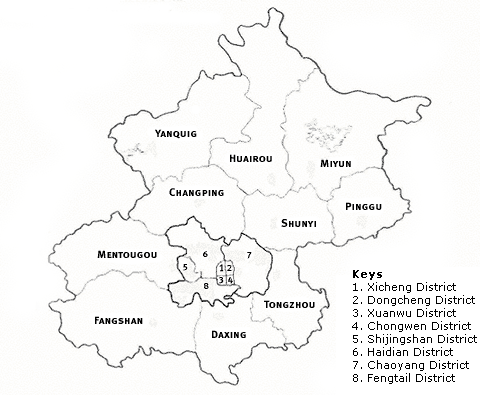
 China’s official Xinhua news agency has run an article, reprinted in the English language China Daily and the People's Daily, discussing the merits and problems of one of the latest in Cultural Revolution Chic theme restaurants in Beijing, the Red Flag Fluttering, in the Daxing district of Beijing.
 Now, Red Flag Fluttering has the requisite Cultural Revolution decor, highlighting Workers, Peasants and Soldiers, propaganda posters, and Mao portraits, and has a nightly song-and-dance routine playing off of the music and shows of the Cultural Revolution period. The article discusses some of the social controversy over the restaurant, and its treatment of the Cultural Revolution, with some criticizing the restaurant for making light of a difficult and terrible time, and others enjoying the memories.
 When I saw the article, two things struck me. First, Red Flag Waving seems to be a knock-off of The East Is Red, which is located east of
 But aside from thinking that Red Flag Waving is just a knock-off of the always-packed East Is Red (showcasing the entrepreneurial spirit of the Chinese, ready to fly with whatever idea works to make a buck... or yuan), the most striking thing was the more open discussion of the Cultural Revolution. The current leadership is the CR generation. They were the sent down students, and they are now exerting their influence and power across the nation. They are also flirting with a more open discussion of just what happened during the CR, of the failure of the Chinese leadership (and the Party itself), and the significant damage all of this caused.
That is allowing open criticism, and that is, in some ways, good and cathartic for the Chinese. Living with pent-up anger and frustration at the delays and damage of the CR certainly affects several of my Chinese acquaintances, some of whom more recently have begun talking about the CR time (and not without some twinge of pain in their voices). One recounted how their teachers were locked up, and some of the older teachers, so confused and upset about what was happening, simply beat themselves to death by steadily pounding their own heads into the concrete wall of their school where they had been locked up. Another complained about the delay in education, and bemoaned the problems the CR caused for
But as the Xinhua article notes, not everyone is ready to talk about the CR, or at least not openly. And certainly not everyone is prepared to let it go, to take a few liberties with the past and revive some of the perhaps fond memories there were. And there seems to have been some. At East Is Red, the audience of 40- and 50-somethings sing along lustily with the CR songs, waving their red flags and raising their beers. And there was a sense of Chinese doing their own thing, of self reliance and national mobilization that is so anathema to the current self-focused race to economic wealth.
So the question I have is – of the CR becomes more acceptable to talk about (and exploit for economic gain), then perhaps we are less than a generation away from the ability of the Chinese to address

A snippet of video from the show at The East Is Red, from YouTube.
South Korean media is highlighting the visit both because it is Kim's first appearance in a month, and because it comes amid heightened political tensions between the North and South. In addition to finally opening the taps on the vitriolic rhetoric condemning South Korea’s new president Lee Myung Bak, North Korea has also revived the threats of turning Seoul to ash (apparently an evolution from the old "Sea of Fire" warning), flown sorties with its old MiG 21s, and started posturing in the East Sea (both warning of naval clashes and testing surface to ship missiles).
But there is another element of the visit that still has me wondering. What is with all the visits to Unit 776? Normally, North Korean media simply mixes up the numbers – and there is not necessarily a clear correlation between the number printed in the media and any real unit number. But Kim has visited some element of Unit 776 now in December 2007, January, February and now April – four visits to the same unit designation. As I noted back in February, Kim’s visits to 776 may have something to do with
With a deal between Washington and Pyongyang in the final stages of negotiation on North Korea's listing of nuclear facilities, perhaps Kim is making sure things are cleaned up and ready up north for inspection after listing.
Or maybe it has nothing to do with the nuclear facilities at all. But the repetition of unit 776 does not seem to me to be a random event.